Sho Shogi
Sho Shogi (or Little Shogi) was the precursor of modern Shogi and was similar in most respects to the game which replaced it in the sixteenth century. The major difference is that Sho Shogi did not include the capacity to re-enter (drop) captured pieces back into play, and that a piece, called the Drunken Elephant plays a role in the game.While Little Shogi was no doubt popular in Japan, there is very little literature on the game. The 1696 edition of 'Sho-Shogi Zushiki' includes a single diagram which shows the Sho Shogi board set-up to be identical with the modern game but for the presence of the Drunk Elephant (a piece known from Middle Shogi). The text states that this piece was removed by order of Emperor Gonara (reigned 1536-1557). As the Drunk Elephant promotes to a piece (the Crown Prince) that is effectively a second King, it did not lend itself to a game played with drops. The removal of the Drunk Elephant has therefore been linked with the transition to the modern game.
The presence of the Rook, Bishop and Drunk Elephant make Little Shogi a far more interesting game than the even earlier game from Heian times, but without drops it lacks the strategy and unique excitement of Modern Shogi.
While the exact rules of the game are not known, Steve Evans has reconstructed a set of rules for the purposes of his Shogi Variants program, based on the rules of the larger Chu and Dai Shogi, which were themselves contemporary to and based on Sho Shogi.
Rules
Sho Shogi is played on a board of 9 x 9 squares and each player has 21 pieces (including 9 pawns).As in all Shogi games, the pieces are flat and wedge-shaped and are not distinguished by colour. Although the pieces are of uniform colour the first player is still conventionally referred to as 'Black' and the second player as 'White'. Ownership of the pieces is indicated by the direction in which they face, with a player's pieces always pointing towards the opponent.
The players make alternate moves, with the object being to capture the opposing 'King'. If the opposing player has obtained a 'Crown Prince' by promotion, that piece must also be captured in order to win the game.
The game can also be won by capturing all pieces except the 'King' (the 'bare king' rule). A bare King may secure a draw if it can also bare the opposing 'King' on the following move.
On each turn a player can move one piece according to its power of movement to a vacant square on the board, or to a square occupied by an enemy piece (in which case the enemy piece is captured and removed from the game).
The setup
The setup is shown below. Note that it is identical to the setup of standard Shogi, except that each player has in addition a drunken elephant on the square before his king.
The Pieces
The pieces and the way they move are shown in the diagram below. Note that all pieces move as in Shogi. The drunken elephant moves one square in any direction except straight backwards. The crown prince (a promoted drunken elephant) moves one square in an arbitrary direction.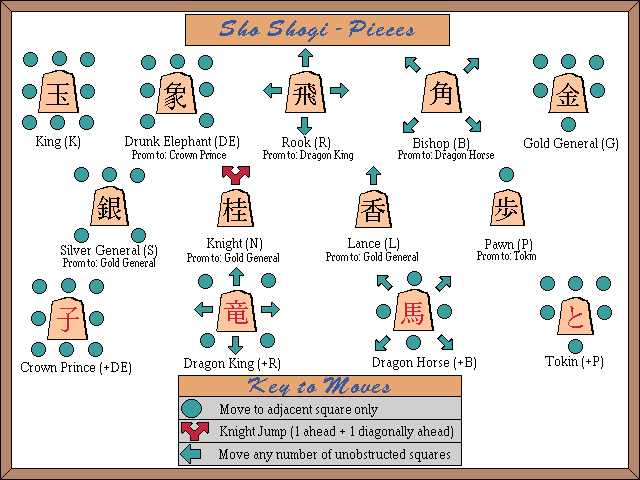
Jumping Pieces
The 'Knight' is the only piece in Sho Shogi that has the power to jump over occupied squares. The Little Shogi 'Knight' has the same move as the equivalent piece in the Western game (ie: it may move one square orthogonally then one square diagonally), except that its move is limited to the forward direction only.The Crown Prince
The 'Drunk Elephant' is potentially a very important piece, as it promotes to a 'Crown Prince'.A player who gains a 'Crown Prince' effectively acquires a second 'King' as the 'Crown Prince' must also be captured (or bared) before the opponent can win the game.
Promotion
Each player has a Promotion Zone consisting of the three ranks (rows of squares) furthest away from him. All pieces except the 'King' and 'Gold General' have a promoted rank and can promote on entering, moving within, or leaving the Promotion Zone.On promotion:
- The 'Rook' gains the power to move 1 square in any diagonal direction. The 'Promoted Rook' is known as the 'Dragon King'.
- The 'Bishop' gains the power to move 1 square in any orthogonal direction and its promoted form is called the 'Dragon Horse'.
- The 'Drunk Elephant' becomes a 'Crown Prince' which has the powers of the 'King'.
- All other pieces move as a 'Gold General' on promotion.
As in all the games in the Shogi family, in Sho Shogi sets the promoted rank is shown on the reverse side of the piece, and the piece is turned over on promotion to reveal the new rank.
Captures
Unlike in Modern Shogi, captured pieces in Sho can not be 'dropped' back into play. A captured piece is removed from play and takes no further part in the game.WWW page created: April 2, 1997.
WWW page created by Hans Bodlaender, based on a text written by Steve Evans for his Shogi Variants Program. Also, images were taken from that program. Text and images used with permission from Steve Evans. The information on this game was based on an article by John Fairbairn, titled Shogi History & the Variants in the September 1980 issue of Shogi magazine.