Kings court
Advanced chess
This game was invented by Sidney LeVasseur in 1997
The board - The board comprises 96 squares, 8 ranks and 12 files, colored alternately light and dark. The players, designated white and black, sit on opposite sides. The board is placed so that there is a dark square in the left hand corner of each player.

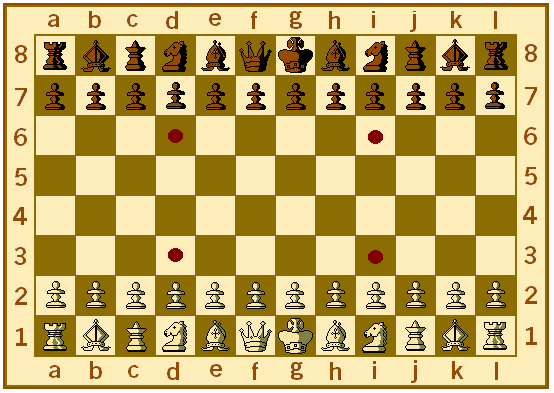
The pieces - Each player has 24 pieces, which are placed on the board at the beginning of the game as showing in figure 1. The pieces are distinguished by their shapes into 8 kinds:
White: King g1, Queen f1, Chancellors c1 and j1, Rooks a1 and l1, Bishops e1 and h1, Knights d1 and i1, jesters b1 and k1 and the pawns one on each square of the second rank.
Black: King g8, Queen f8, Chancellors c8 and j8, Rooks a8 and l8, Bishops e8 and h8, Knights d8 and i8, Jesters b8 and k8 and the pawns one on each square of the seventh rank.
Moves
The Queen, Rooks, Knights, Bishops and Pawns move the same as in chess.
The King moves the same as in chess with the exceptions of "castling" and "Kings flight".
The Chancellor has two possible moves (1) It can move one or two Squares (not jumping) in any direction. (2) It can move as a Knight. see figure 2.

The Jester moves one or two squares on the diagonals. Unlike the Bishop the Jester can change directions while in motion. It may not return to the square from which it started in the same move. See figure 3. For the first move from its initial square the Jester may jump two squares diagonally. See figure 4.
Castling - is a compound move of the King and the Rook that may be made, if at all, only once in the game. It is legal if neither the King nor the Rook has yet moved; if all squares between them on the rank are vacant and no adverse pieces commands a square that the King will pass over; and if the King is not in check. The move is executed by moving the King one, two, three or four squares toward the Rook, and then placing the Rook on the square last passed over by the King. Either the King-Rook or the Queen-Rook may be used in castling.
Kings flight - is a move made by the King when in check by the Chancellor. The move is executed by moving the King two squares in any direction instead of its usual one square. The kings flight is an optional move, it is not a required move when in check.
Object of play - The game is won by capturing the adverse King. The capture is never consummated; when the King is attacked and cannot escape, he is said to be checkmated and the game ends forthwith. Many games end by resignation of a player who sees that he cannot escape eventual defeat. A threat to capture the adverse King is a check; a check must of course be averted or the game forfeited. The only ways of meeting a check are to move the King, capture the attacking piece or interpose on the line of the check given by a distant Queen, Chancellor, Rook, Bishop or Jester.
Drawn games - A game may be abandoned as drawn for any of the following reason:
- Insufficient force - the pieces remaining on the board do not suffice to force checkmate.
- Stalemate - the player in turn to move has no legal move but is not in check.
- Perpetual check
- Agreement - the players agree to abandon the game.
- Recurrence - If the same position of all forces recurs three times, a player may claim a draw.
- The fifty move rule - when the player whos turn it is to move proves that at least 50 moves have been made with out a piece being capture or a pawn advancing.
Rules and pieces that are different than orthodox chess: castling, Kings flight, the Chancellor and the Jester.
Any comments or suggestions please e-mail: (email removed contact us for address) oo.com
Written by Sidney LeVasseur. HTML conversion by David Howe.
This variant is an entry in the 1999 Large Variant contest.
WWW page created: April 1, 1999. Modified: 23 April 2001.