Slanted Escalator Chess
By David Short
Introduction
Here's a pretty simple chess variant that I've created. Slanted Escalator Chess is a Chess variant with with same pieces as usual Chess -- except the Pawns are replaced by the more capable Crabs -- but with an unusual asymmetric board.
Board and Setup
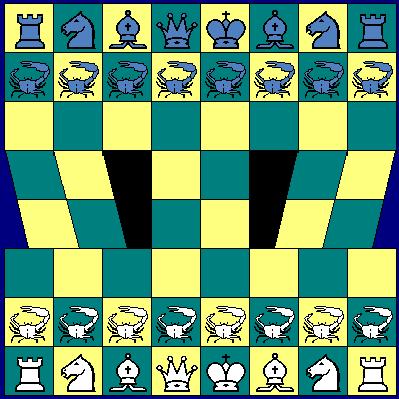
              a    b    c    d    e    f    g    h
            +----+----+----+----+----+----+----+----+    Black
         8  |*R**|*N**|*B**|*Q**|*K**|*B**|*N**|*R**|  8
            +----+----+----+----+----+----+----+----+
         7  |*C**|*C**|*C**|*C**|*C**|*C**|*C**|*C**|  7
            +----+----+----+----+----+----+----+----+
         6  |    |::::|    |::::|    |::::|    |::::|  6
            +----+----+----+----+----+----+----+----+
         5  \ab5 \bc5 \XXXX|    |::::|XXXX/fg5 /gh5 /  5
             \----\----\XXX+----+----+XXX/----/----/
         4    \ab4 \bc4 \XX|::::|    |XX/fg4 /gh4 /    4
            +----+----+----+----+----+----+----+----+
         3  |::::|    |::::|    |::::|    |::::|    |  3
            +----+----+----+----+----+----+----+----+
         2  | C  |:C::| C  |:C::| C  |:C::| C  |:C::|  2
            +----+----+----+----+----+----+----+----+
         1  |:R::| N  |:B::| Q  |:K::| B  |:N::| R  |  1
            +----+----+----+----+----+----+----+----+    White
              a    b    c    d    e    f    g    h
Note that in the above ASCII diagram, BLACK pieces are surrounded by
**asterisks**.
Rules
All of the rules are the same as usual Chess with the following exceptions:
- All of the Pawns are replaced by Crabs. A Crab may, in addition to moving and capturing like a regular pawn, also make a non-capturing move by moving one square diagonally forwards. A Crab may move two squares forwards on its initial move, but may not move two squares diagonally forwards on its initial move. Crabs may capture and be captured en passant, and promote to a Queen, Rook, Bishop or Knight upon reaching the last rank, and there is no restriction on promotion. Crabs do not move backwards.
-
The only other difference in this game between standard chess
is the board. Note the irregular shape. The columns on the
sides of the boards remind one of those moving flat escalators
one sees in airports. You hop on and ride it to the end.
In the ASCII diagram above, each square has been widened to better
illustrate the special features of the squares. The co-ordinates
of the squares has been written inside the escalator squares.
The best way to describe how these escalators work is probably
to painstakingly go over each and every possibility.
Describing how the pieces on the escalator rows is not easy without risking confusing the reader. I do not wish to imply that pieces "slide" on the escalators and move to the end. They do not. They move normally.
A piece on a3 can move straight forwards or diagonally forwards to ab4. A piece on b3 can move straight forwards or diagonnaly forwards to ab4 or bc4. A piece on c3 can move straight forwards or diagonally forward to bc4. A piece on f3 can move straight forwards or diagonally forward to fg4. A piece on g3 can move straight forwards or diagonally forwards to fg4 or gh4. A piece on h3 can move straight forwards or diagonally forwards to gh4. What this simply means is, for example, either a Rook or Bishop could move from a3 to ab4 or vice-versa.
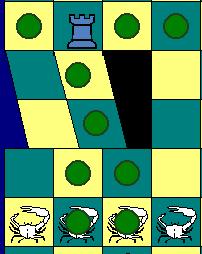
Confused? let me see if I can explain it better
A piece on ab4 moves forwards to ab5 but diagonally forwards to bc5 ab4 moves backwards straight to a3 or b3 or backwards diagonally to a3 or b3. White pieces moving backwards, or black pieces moving forwards, can go from ab4 to a3 or b3, and from gh4 to g3 or h3. This is true both for pieces moving straight or diagonally. White pieces moving forwards or black pieces moving backwards can go into ab4 from a3 or b3, into bc4 from b3 or c3, into fg4 from f3 or g3, and into gh4 from g3 or h3, regardless of whether they are moving straight or diagonally. This is not to imply that they move one square and automatically stop. They may continue moving if legal and so desired.
For pieces which move forwards, its pretty simple to visualize how they would move on the escalators. The tricky part is explaining how diagonally moving pieces move. Perhaps I can best explain it by stringing along the co-ordinates of the existing diagonals. For instance in regular chess there is a diagonal which runs: a1-b2-c3-d4-e5-f6-g7-h8, there's another one which runs: a4-b3-c2-d1, and also one from a4-b5-c6-d7-e8. In Slanted Escalator Chess the diagonals run:
- a1-b2-c3-d4-e5-f6-g7-h8
- b1-c2-d3-e4
- c1-d2-e3
- d1-e2-f3-fg4-gh5
- e1-f2-g3-gh4
- f1-g2-h3
- g1-h2
- b1-a2
- c1-b2-a3
- d1-c2-b3-ab4
- e1-d2-c3-bc4-ab5
- f1-e2-d3
- g1-f2-e3-d4
- h1-g2-f3-e4-d5-c6-b7-a8
- a2-b3-bc4 h2-g3-fg4
(the others on the second rank do not need to be listed since they are the same as the ones that originate on the first rank listed above)
- a3-ab4-bc5-c6-d7-e8
- h3-gh4-fg5-f6-e7-d8
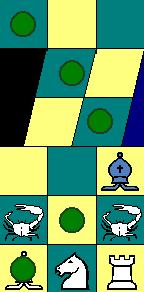
(the others on the third rank do not need to be listed since they are the same as the ones that originate on the first or second rank listed above) Even though it is redundant at this point to list the diagonals for the escalator squares I will do so again for further clarification and understanding:
- ab4-bc5-c6-d7-e8
- bc4-ab5
- fg4-hg5
- gh4-fg5-f6-e7-d8
- ab5-b6-c7-d8
- bc5-a6
- fg5-h6
- gh5-g6-f7-e8
The rest of the diagonals are pretty obvious.
Pieces on the escalator squares may also move laterally. For instance: ab4 <---> bc4, ab5 <---> bc5, fg4 <---> gh4, and fg5 <---> gh5
Further illustration can be given by citing examples.
(*-assuming the way is unblocked by enemy pieces)
FROM            PIECE            MAY MOVE TO*
----            -----            -----------
a3     (white)  CRAB             ab4 only
a3              ROOK             ab4,ab5,a6,a7,a8, or a2,a1
a3              KNIGHT           b1,c2, or  bc5 (via a3-ab4-ab5-bc5)
                                 or  bc4 (via a3-b3-c3-bc4)


a3              BISHOP           b2,c1 or ab4, bc5, c6, d7, e8
a3              QUEEN            same as Rook or Bishop
a3              KING             a2,b2, b3, or ab4

b3    (white)   CRAB             ab4 or bc4
b3              ROOK             ab4-ab5-a6-a7-a8 or
                                 bc4-bc5-b6-b7-b8  or b2-b1
b3              KNIGHT           ab5,bc5,d2,d4
b3              BISHOP           a2,c2,d1,ab4 or bc4
b3              QUEEN            same as Rook or Bishop
b3              KING             a2,b2,c2,a3,c3, or ab4 or bc4

c3    (white)   CRAB             bc4 or d4
c3              ROOK             c2-c1, b3-a3, d3-e3-f3-g3-h3 or
                                 bc4-bc5-b6-b7-b8
c3              BISHOP           b2-a1, d2-e1, bc4-ab5 or
                                 d4-e5-f6-g7-h8
c3              QUEEN            same as Rook or Bishop
c3              KING             a3-d3-b2-c2-d2 or bc4 or d4
Note also that a white Crab on b2 could move on its initial move to either b3, or into ab4 or bc4. Likewise a white Crab on g2 could move to either g3, or into fg4 or gh4.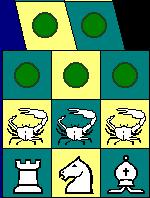
Likewise, a white Crab on a2 could move on its first move to either a3 or ab4, a white Crab on c2 could move on its first move to either c3 or bc4, a white Crab on f2 could move on its first move to either f3 or fg4, and a white Crab on h2 could move on its first move to either h3 or gh4.
Note that a piece on b3 controls both ab4 and bc4, and that a piece on g3 controls both fg4 and gh4. This is true regardless of whether it is a white piece or black piece (except for black Crabs which cannot move backwards, or Knights which don't move exactly one square) and regardless of whether it moves straight or diagonally. Likewise, a piece of either color (except for white Crabs or Knights) on ab4 controls both a3 and b3, on bc4 controls both b3 or c3, on fg4 controls both f3 and g3, and on gh4 controls both g3 and h3. controls is defined as a piece having the ability to move into that square if vacant, or capture an enemy piece.
Note also that it is conceivable for Bishops to switch their colors using the escalator squares. This is completely legal in this game.
I should think that at this point everything else is self-explanatory, but try familiarizing yourself with the game by clicking on each piece when playing this game with Zillions of Games, if you have it, and noting the green dots which illuminate to indicate all of the squares that that piece may legally enter.
- The one drawback to this game is that white can take advantage of the escalators more quickly than black can. To compensate for that, black makes the first move in this game.
-
No piece may enter the areas marked by "X"s in the above diagram,
nor may they move over them. For instance, d4 cannot get to
b6 and vice-versa. bc4 cannot get to d6 and vice versa.
e4 cannot get to fg4 and vice-versa.
The only exception are the Knights. Knights MAY jump over
the X-barriers! Thus, the following moves are legal for
Knights of either color:
d4 to bc5 or vice-versa
d5 to bc4 or vice-versa
e4 to fg5 or vice-versa
e5 to fg4 or vice-versa
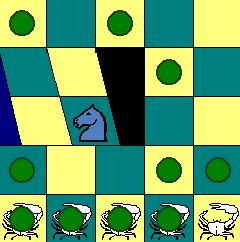
- En Passant: A white Crab on the 5th rank may capture a black Crab which makes an initial two-step move from the 7th rank en passant the same as it would if they were pawns in regular chess. Likewise for a black pawn on the 4th rank capturing en passant a white Crab making an initial two-step move from the 2nd rank.
Castling is exactly the same as it would be in usual Chess. All other rules of usual Chess apply, including draw by stalemate, three-fold repetition and the 50-move rule (no captures or Crab moves for 50 consecutive moves).
Variant
Finally, please note that an interesting variant of Slanted Escalator Chess (but a rule not to be used in the original version of this variant) would be to allow pieces to "bounce" off of ab4,ab5,gh4 and/or gh5 when moving diagonally and continue along in the opposite direction.
For instance, in usual Chess, this variation would be used to, let's say, allow a Bishop or Queen which moves from d1 (or c2 or b3) to a4, and then continue as far along the opposite diagonal as it wishes, to b5, c6, d7 or e8. This has been described as a "ricochet" effect, like a bullet bouncing off a wall, carreening in the opposite direction. I could see this idea being used in my game, but I was reluctant to encorporate it into my game. The idea is that it should be harder to transverse the board, not made easier with tricky shortcuts like this. But still one could play around with such an idea as a further variation to the game if they wished.
Computer Play
An implementation of Slanted Escalator Chess has been written for Zillions of Games. You can download it here:
The ZRF contains some variants: Slanted Escalator Chess without cross-barrier Knight moves and Almost Slanted Escalator Chess. The former is the result of a discussion between the author and the editor on whether the Knights ought to be able to leap the barriers/holes. The latter is a combination of Slanted Escalator Chess and Ralph Betza's Almost Chess, where the Queens are replaced by Chancellors. (Since Rooks and Knights benefit the most from Slanted Escalator Chess' board, Chancellors, which combine both, are great deal of fun on it.)
Written by David Short. HTML conversion by Peter Aronson.
WWW page created: April 8th, 2002.