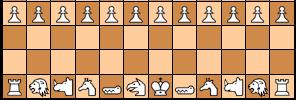
The Piececlopedia: The Rook-Knight Compound
Empress, Marshall, Chancellor
Historical remarks
This piece has a long history and has been called by many names. Some of the earliest names for this piece are Champion and Dabbabah, but these two names are currently the accepted names for two other pieces. The Champion is a piece in the commercial variant Omega Chess, and the Dabbabah names the historical piece it was more commonly used for. The three most widely used names for this piece are Empress, Chancellor, and Marshall.
Empress is the standard name for the piece among fairy problemists. This name is used as the favored name in both Dickin's Guide to Fairy Chess and The Oxford Companion to Chess. The rationale behind this name is an analogy with the Queen. This piece, the Queen, and the Bishop/Knight compound are the three main compounds of the three simple pieces in Chess, the Rook, Bishop, and Knight. The idea is that, like the Queen, all three of these compounds should be named after female royalty. Since the Rook is stronger than the Bishop, this piece was considered the stronger of the two compounds besides the Queen. So it got the name Empress, while the name Princess went to the Bishop/Knight compound. One difficulty with the name Empress is that it suggests that the piece is more powerful than the Queen, whereas it seems likely that the Queen is the more powerful of these two pieces. In fact, because of the suggestion that an Empress should be more powerful than a Queen, John William Brown gave the name of Empress to the Knight-Queen combination usually known as an Amazon.

The name Marshall, or Marshal, dates back to 1840, when L. Tressan used it in The Sultan's Game. The name Chancellor dates back to 1887, when Ben Foster used it in Chancellor Chess. In the 20th century, Jose Capablanca made use of both names. He first used the name Marshall, then later changed to using the name Chancellor. Both names have also been used in well-known commercial variants. Christian Freeling used the name Marshall in Grand Chess, and Ed Trice used the name Chancellor in Gothic Chess.
Although both names have enjoyed popularity during the last century, there seem to be a few reasons for favoring the name Marshall. First, the name Marshall has more consistently been used for this piece, whereas the name Chancellor has more frequently been used for other pieces. Capablanca used it for the Knight-Bishop compound, and Sidney LeVasseur has used it for another piece in Kings Court. Second, the letter C is commonly used for other popular pieces, such as the Camel, the Cannon, and the Champion, not to mention the Cardinal, the variant piece most frequently paired with this piece. Given the popularity of this piece, it would confuse things to use the letter C for this piece too. Etymologically, the name Marshall fits a piece with Knight moves better than Chancellor does. Marshall literally means horse-servant, being related to the English word mare, meaning a female horse. One especially relevant definition of Marshall is cavalry commander. In contrast, the name Chancellor has nothing to do with horses. It comes from a Latin word literally meaning doorkeeper, and it generally refers to a head of state or to a college president. It also has some ecclesiastical definitions, which Capablanca may have had in mind when he gave the name to the piece he also called the Archbishop. Finally, for whatever it's worth, Marshall is the older name.
This table gives an overview of the history of this piece.
| Year | Game | Name of Piece | Creator of Game | 14th century? | Shatranj Al-Kabir (Great Chess) | Unknown |
|---|---|---|---|
| 1617 | Carrera's Chess | Champion | Pietro Carrera | 1747 | The Duke of Rutland's Chess | Concubine | John, third Duke of Rutland |
| <= 18th century | Turkish Great Chess | Dabbaba (War Machine) | Unknown |
| 1840 | The Sultan's Game | Marshall | L. Tressan |
| 1874 | Bird's Chess | Guard | Henry Bird |
| 1887 | Chancellor Chess | Chancellor | Ben Foster |
| 1920's | Capablanca Chess | Marshall / Chancellor | J. R. Capablanca |
| <= 1943 | Wolf Chess | Wolf | Dr. Arno von Wilpert(?) |
| 1950-1975? | Cagliostro's Chess | Chancellor | Savio Cagliostro |
| 1978 | Tutti-Frutti Chess | Empress | Ralph Betza and Philip Cohen |
| 1980 | Renniassance Chess | Nobleman | Eric V. Greenwood |
| 1984 | Grand Chess | Marshall | Christian Freeling |
| 1996 | The Remarkable Rookies (CDA) | Chancellor | Ralph Betza |
| 1997 | New Chancellor Chess | Chancellor | David Paulowich |
| 1997 | Paulowich's Chancellor Chess | Chancellor | David Paulowich |
| 1997 | Cobra Chess | War Machine | Derick Peterson |
| 1997 | Grand Hexachess | War Machine | Derick Peterson | 1998 | Euchess | Marshall | Carlos Cetina |
| <= 1998 | Chess 2000 | Knight/rook | Gerhard Josten |
| 1998 | Eric's Great Chess | War Engine | Eric Greenwood | 1998 | Pre-Grand Chess | Marshal | Eric Greenwood |
| 1998 | Cavalier Chess | Marshall | Fergus Duniho |
| 1999 | Unicorn Chess | Chancellor | David Paulowich |
| 1999 | Haynie's Great Chess | Marshall or Chancellor | Billy Haynie |
| 1999 | Pick-the-Team Chess | Chancellor | Hans Bodlaender |
| 1999 | Hexmate | Duke | Michael A. Rouse |
| 1999 | Grand Cavalier Chess | Marshall | Fergus Duniho |
| 1999 | Bedlam | Marshall | Fergus Duniho |
| 1999 | Metamorphin' Fusion Chess | Marshall | Fergus Duniho |
| 1999 | Fusion Chessgi | Marshall | Fergus Duniho |
| 1999 | Fusion Chess | Marshall | Fergus Duniho |
| 1999 | Metamorph Chess | Marshall | Fergus Duniho |
| 2000 | Giant Chess | Chancellor | Köksal Karakus |
| 2000 | Perfect Chess | Chancellor | Köksal Karakus |
| 2000 | Terror Chess | Marshall | Brian Wong |
| 2000 | Turkish Chess | Chancellor | Köksal Karakus |
| 2000 | Trihex | Marshall | Marek 14 |
| 2000 | The Knightliest Black Hole | Duke | João Pedro Neto |
| 2000 | Drop Chess | Cardinal | Key McKinnis |
| 2000 | Fantasy Grand Chess | Marshall | Peter Hatch |
| 2000 | Blackhole Chess | Marshall | David Short |
| 2001 | Gigachess | Marshall | Jean-Louis Cazaux |
| 2001 | Four Towers | Marshall | Jim Aiken |
| 2002 | Abecedarian Big Chess (ABChess) | Marshal | Glenn Overby |
| 2002 | Full Double Chess | Chancellor | Sergey Sirotkin |
Movement rules
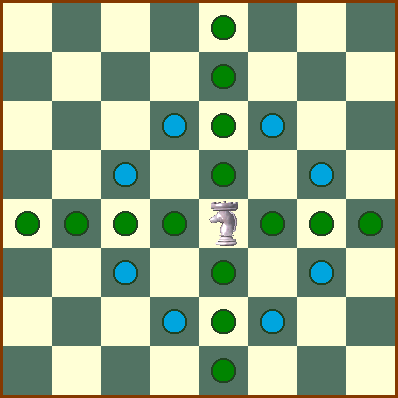
The Marshall may move like a orthodox chess Rook, or like a orthodox chess Knight.
Movement diagram
The blue circles indicate the leaping moves of a Knight, while the green circles indicate the Rook move.
Alternate Images
Click on an image to view the full piece set it belongs to.
 |
 |
 |
 |
 |
 |
 |
|
 |
This is an item in the Piececlopedia: an overview of different (fairy) chess pieces.
Written by Fergus Duniho and David Howe.
The Meta-Chess move map was reprinted from Meta-Chess, copyright 1997, by permission of John William Brown.
Movement diagram and piece icon created from Zillions of Games.
WWW page created: February 12, 1999.