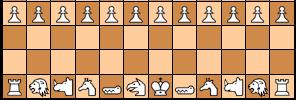
Piececlopedia: Long Leaper
Historical notes
The long leaper was invented by Robert Abbott for his game Ultima . The rules for Ultima were first published in 1962.
Movement
The long leaper moves as a chess queen, but does not capture this way, and can never move to an occupied square. When a long leaper captures, it does so by landing on the square immediately beyond the piece it is capturing. If there is another capture available in the same direction, then it can continue as far as it desires.
Movement diagram
In the diagram below, the long leaper (represented by the symbol for the knight, since the game Ultima uses a chess knight to represent the long leaper) can move to any of the circles marked with a black circle. If it moves to a3, it captures the rook (coordinator) on b4. If it moves to d3, it captures the rook (coordinator) on d4, and it can also continue to d1 in the same turn, capturing the bishop (chameleon) on d2. Note that it can not capture either pawn, nor either of the knights (long leapers).


Remarks
The long leaper is a fairly powerful piece. It has the mobility of a queen, and can capture defended pieces without fear of retribution. However, a long leaper and a king can not checkmate a lone king.
This is an item in the Piececlopedia: an overview of different (fairy) chess pieces.
Written by Benjamin C Good.
WWW page created: September 14, 1998.
Modified: D. Howe on March 5, 2000 (Long Leaper is a Knight, not a Bishop).