Weave & Dungeon
by W. D. Troyka
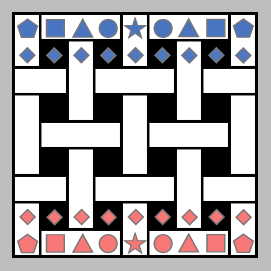
Weave & Dungeon is a warped game. It is played on a 9x9 weave pattern set against a black background. The white spaces as a group are called the Weave. The black spaces are called the Dungeon. The Weave and the Dungeon constitute separate playing fields that interact with one another. Motion on the Weave is twisting and non-Euclidian. Motion in the Dungeon is traditional and linear.The Board
The Weave consists of five vertical strands interwoven with five horizontal strands. Each strand is broken into two or three segments by cross-strands. The segments in turn consist of two or three spaces. A space located at the intersection of two strands is called a bridge. A space laterally adjacent to a Dungeon space is called a slope. The strands can be thought of as sine curves viewed from above. Bridges are located at the crests of each curve, and slopes connect bridges to the (hidden) troughs of the curve. An adjacent bridge and slope are continuous if located in the same strand. They are normal, i.e., perpendicular, if located in different strands. The Dungeon consists of sixteen black spaces called cells. Cells are considered adjacent if separated by a single Weave space.
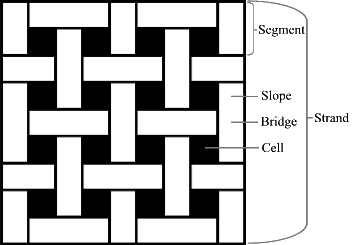
The board contains a number of implied spaces through which pieces can move but which can never be occupied. An implied underpass is the trough of a strand located directly beneath the bridge of a cross-strand. An implied cell is a Dungeon space located directly beneath a Weave space. The vertical dimension of the board has four altitudes. Cells are located at the bottom altitude, followed upwards by underpasses, slopes, and bridges. Notation is the same as for a 9x9 chess board.
Motion
There are two types of motion: sliding and stepping. Sliding consists of continuous motion along a smooth surface. Pieces slide when moving within the Dungeon or along a strand. A step occurs when a piece abruptly changes altitude by moving across an edge. Pieces step when moving between a normal bridge and slope, or between the Weave and the Dungeon.A single move can combine sliding and stepping. An important example is "stepping down from one segment to another," or "segment stepping." This occurs when a piece, starting from any space in a segment, slides to the bridge of the segment (if not already there), steps down to a normal slope, and comes to rest on any space in the new segment. A piece that steps down from one segment to another must always step as part of the move. It cannot start and stop within the same segment.
Segment stepping can occur in only one direction around a given cell. A segment stepper can circle cell d4, for example, only in the counterclockwise direction. A piece stepping around cell h4 must follow the clockwise direction. This pinwheel effect means that attacks by segment steppers are not necessarily reciprocal.
All pieces capture by replacement. With the exception of the Circle, a piece cannot move across an occupied space. Pieces can, however, move underneath other pieces when taking an underpass or an implied cell.
The pieces are designed to take advantage of the board's unique features, including underpasses, pinwheel effect, and dual playing fields. Because most pieces commute freely between the Weave and the Dungeon, move definitions must state how a piece moves on the Weave, within the Dungeon, and between the Weave and the Dungeon.
|
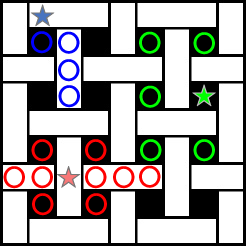
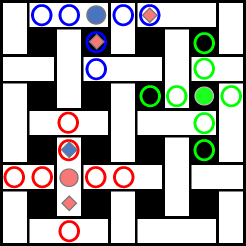
StarThe Star steps down from one segment to another. It enters the Dungeon by stepping into an adjacent cell. Within the Dungeon it slides to an adjacent cell. It can never exit the Dungeon. When both Stars are in the Dungeon, they do not give check along a diagonal (the "diagonal check rule"). |
CircleThe Circle moves one or two spaces orthogonally. It can jump over (or slide under) an intervening piece of either color, which is unaffected by the jump. Its motion is the same whether on the Weave or in the Dungeon. |
|
Triangle
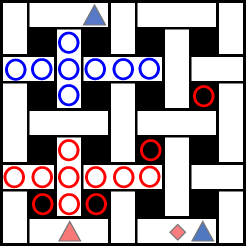
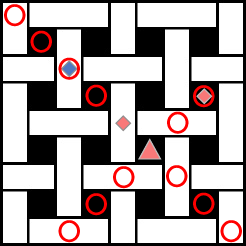
The Triangle steps down from one segment to another, from which it may step down to another. The second step is optional. It enters the Dungeon by stepping from a bridge to an adjacent cell. It may continue moving in the same diagonal direction any number of cells. Within the Dungeon it slides in a diagonal line any number of cells. It exits the Dungeon onto an adjacent bridge, either directly or after sliding.
|
|
Square
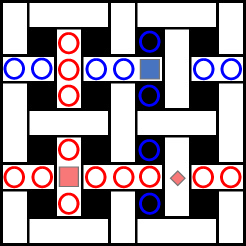
The Square slides to any space on the strand on which it is located. If on a bridge, it may move to any space on the strand passing underneath. It enters the Dungeon by stepping down from a slope to an adjacent cell. It may continue moving in the same orthogonal direction any number of cells. Within the Dungeon it slides in an orthogonal line any number of cells. It exits the Dungeon onto an adjacent slope, either directly or after sliding.
|
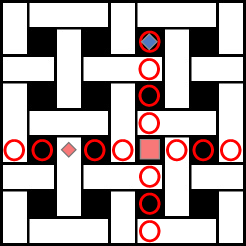
|
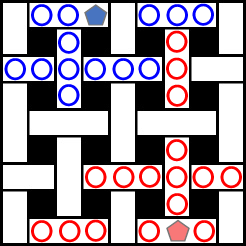
PentagonThe Pentagon moves on the Weave like either a Triangle or a Square, at its option. It can never enter the Dungeon. |
|
|
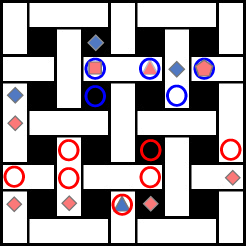
DiamondThe Diamond moves forward one space or one cell. Within a segment it may slide forward two spaces. It captures one space forward or one space to the side but only when stepping. Upon reaching the far row it may rescue any previously captured friendly piece. The rescued piece is exchanged for the Diamond. |
Object
Win by checkmating the opponent Star. Stalemate and repetition are a loss.The bridge on which the Star begins the game is called its throne. A Star that steps off its throne is said to abdicate. It is imprisoned when it enters the Dungeon. In a typical game one or both Stars are forced into the Dungeon, from which they are helpless from checks delivered from the overhanging Weave. The Stars are quite mobile, however, and are often chased throughout the Dungeon before checkmate can be achieved. The diagonal check rule is designed to maximize Star mobility in the Dungeon.
Although a win is a win, Weave & Dungeon grades wins according to quality. A player that wins with his Star unmoved on its throne earns a Triumph, the highest level. A player that wins with his Star on the Weave earns an Ovation. If both Stars are in the Dungeon, the winning player earns a simple Victory.
Strategy
In general, the Triangle is the most valuable piece, followed by the Square, Pentagon, and Circle. The Pentagon has the most coverage on the Weave and is easily moved into play in the opening. As a result, it is an active piece in the early going. Once the opponent Star is imprisoned, its utility drops because it can no longer give check to the Star. The Triangle should not be left on a slope if possible. On a slope it has no access to the Dungeon and can be trapped by any piece that moves to the continuous bridge. Squares should not be left on bridges. A square on a bridge has no access to the Dungeon and may be an easy target for an enemy Pentagon or Triangle. For the same reasons, Circles are better off on slopes and in cells, although when attacking they may need to move from bridge to bridge. Both the Triangle and the Square are more powerful in the Dungeon than on the Weave. The Pentagon has greater coverage from a bridge but is more vulnerable to attack from Triangles. Diamonds can form shields when placed side by side with a step between them. Each protects the other and they serve as a barrier to enemy pieces.The Star is well protected on its throne. It should not be moved unless absolutely necessary. One should never move the Diamond on e2 while the Star is still on its throne, and in general the Diamonds on d2 and f2 should be kept in place. Conversely, offensive strategy is best directed at weakening the royal guard of Diamonds on e8, d8, and f8. A Triangle in the Dungeon can attack the e8 and f8 Diamonds diagonally. If a Square or Pentagon is located on e3, the e8 Diamond is pinned. It is often worth sacrificing a major piece to force the opponent to abdicate. Once the enemy Star is off its throne, its vulnerability to check increases dramatically. The Star is elusive in the Dungeon but a player can gain material through the attack possibilities set up by repeated check.
The game lends itself to a variety of openings. One reliable opening is 1. Da2-a3 ... 2. Db2-b3 ... 3. Pa1-a4 ... 4. Sb1-b4 ... 5. Tc1-b2. Another is: 1. Db2-b4 ... 2. Dc2-c4 ... 3. Sb1-b2 ... 4. Tc1-e3 ... 5. Pa1-c2. Such openings may be interrupted but the ultimate position can often be obtained. It may also be helpful to move a Circle out, e.g., to d4 or to move both Circles out in a tandem attack in which they protect one another. Endgames featuring a Triangle, Square, or Circle against a bare Star are a win. Perhaps the most interesting endgame involves a Triangle versus a Pentagon. Although the Pentagon cannot enter the Dungeon, it can attempt to cover the Weave spaces from which a Triangle can attack the Star. The Triangle must attack from the Weave because, within the Dungeon, it can be captured. Although this ending appears to be a draw, in fact the player with a Triangle can force a win in sixteen moves or less.
Written W. D. Troyka.
WWW page created: September 15th, 2002.