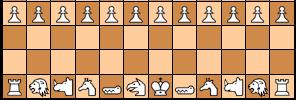
Inertia Chess
See also:
- Chess and Physics. Description of game, in context with several sample games.
Rules
- The FIDE rules apply, except in the following, with the spirit that the last pieces moved continue to move the same way in the next turns.
- There is no notion of castling, check, checkmate and stalemate. The winner is the player that captures the king of the opponent.
- If you moved a piece without making a capture in your last move, you are forced to play the same piece in the same direction without making a capture. If you can't, you are free to play whatever you want following Rules 1-2.
- If you made a capture in your last move, you are forced to play the same piece in the same direction and make another capture with it. If you can't, you are free to play whatever you want following rules 1-2.
- 'Direction' is meant in the oriented sense that there are 16 different directions possible in all, including the knight moves. The distance a queen, a rook or a bishop moves along a direction is left free to the players' choice.
Sample game
Joao - Claude
1. Nf3 a5
2. Ne5 a4
3. Nxf7 a3
4. Nxd8 h5
5. b4 h4
6. b5 h3
7. b6 cxb6
8. gxh3 Ra4
9. Nc3 d6
10. Nd5 Bxh3
11. Nxb7 Rh4
12. Nc7 Kf7
13. Rg1 Kg6
14. Rxg6
1-0
Final board position


Written by: Joao Neto and Claude Chaunier
WWW page created: January 21, 1997. Last modified: February 28, 2001.