Chain of Fools
By
Francois Tremblay
Introduction
Chain of Fools is a Chess variant, where instead of attempting to checkmate the opposing King, your goal is to arrange your pieces in chains where each piece defends the next.
General Rules
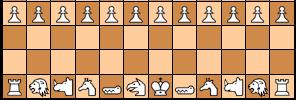
The array and movement rules of FIDE Chess are used, with the following exceptions:
- Pawns may not make an initial double-move, but may move one square directly backwards to an empty square. There is of course, no en passant capture.
- Kings are normal pieces, and may move to attacked squares.
- There is no promotion or castling.
The goal Chain of Fools is to be the first to get earn 10 points by making chains of pieces. These chains have varying values depending on which pieces are used to compose them.
A move consists of the following phases :
- Moving a piece.
- Shuffling (if the first phase was a capture).
- If a chain is formed, claiming, then shuffling. If more than one chain is on the board at this time, the player decides the order of the claiming and shuffling.
Chains
A chain is composed of between 3 and 5 pieces, where every piece in
the chain, except for possibly the last, defends the next piece
in the chain (a piece defends another piece if the piece defended is
friendly and if captured, the defending piece could capture the
capturing piece). Here is an example:
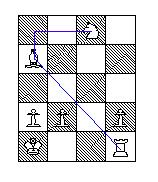
This chain is worth 5 points. |
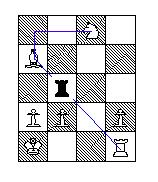
This is not a chain because the Bishop does not defend the Rook. The interfering black Rook would have to be shuffled before this chain could be claimed. Note that the "path" of the Knight is the two consecutive squares first, then the orthogonal square. |
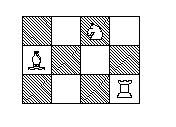
This is not a chain because the Knight defends both of the other pieces. A chain must have links from piece to piece except for the last piece. |
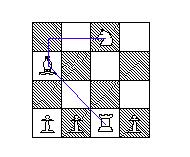
This is a chain because there is a way in which we can make every piece defend another except one, that is, by claiming it as Knight - Rook - Bishop. It would not matter if the Bishop itself defends the Knight or the Rook : as long as the requirements for a chain are met, it doesn't matter what additional pieces members of the chain might defend. |
- Every piece in the chain - except for the last piece - defends the next piece in the chain. The last piece in the chain is not required to defend any other pieces.
- The chain must not have any piece on the first two ranks.
- A chain must have at least one piece not on the same rank as the others.
Claiming and Shuffling
A chain of 3 pieces or more must be claimed on the same turn that it is formed. This means that the maximum possible length for a chain is 5 pieces (being formed from two chains of two pieces each being bridged by the last movement). To claim a chain, it is sufficient to point out the pieces of the chain in succession and count the number of points scored.
If a chain is not announced on the same turn it is formed, either by mistake or design, the opponent must shuffle it immediately when they see it. No points can be scored by either side for such a chain.
Instead of being removed from the game, captured pieces and pieces in chains are shuffled. Shuffling happens in three situations:
- When a piece is captured.
- When a chain is formed and claimed.
- When an unclaimed chain is found.
The method of shuffling is simple : any captured or chain-forming pieces are removed from the board and placed on any empty square by the side that captured or the opponent of the chain-forming player. There is no restriction on the squares that shuffled pieces may be placed on apart from the square having to be empty.
The King can also be shuffled. There is obviously no check or mate.
If a player for shuffles their opponent's pieces such that they form a chain of length 3 or greater, this is treated just like a chain their opponent has formed deliberately. If a shuffling occured during the opponent's claiming and shuffling phase, the opponent may claim it right away, and if they do not claim it and it is still a valid chain at the end of the opponent's turn, it is treated like any other chain left unclaimed. If a player shuffles their opponent's pieces to form a legal chain during the player's turn (due to a capture), their opponent may claim it at the end of the their following turn.
Point Values
The point value of a chain is the sum of the point values of each piece involved.
- Worth 1 point : Pawn, Rook, Queen
- Worth 2 points : Knight, Bishop
- Worth 6 points : King
Optional Rules and Strategies:
A variant of these rules would be to reduce the requirements number of pieces in a chain from three to two, in the following manner:
- Every piece in the chain - except for the last one - can defend a different piece.
- The chain must not have any piece on the forming player's half of the board (on their first four ranks).
This makes forming chains more difficult and makes for closer games.
One obvious tactic is to imprison a Pawn by shuffling it behind one of your own Pawns. Since the Pawn cannot free itself, it can stay trapped while your Pawn scores points on the third row. However, the more deployment done by your Pawn, the more leeway the imprisoned Pawn has.
Written by Francois Tremblay.
WWW page created: April 4th, 2002.