Rules of Tezhi Luzhanqi - Chinese army chess
Tezhi Luzhanqi is a Chinese game that probably already exists for quite some time. More information and photo's of sets can be found elsewhere on this website.There are several, related but sligtly different sets of rules. Below, you find common rules for the different variants, and specific rules, as I received them from Richard Tan and Maarten Bodlaender.
Rules
The game is played by two players, playing with red and green. Depending on the variant, a third person sometimes acts as `referee'.The board
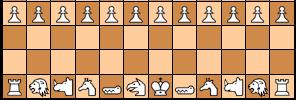
The board, as shown below features lakes, railroads, normal connections, positions that are marked with rectangles, circles, or `main camp'. Below, you see a drawn diagram, and a scanned board.

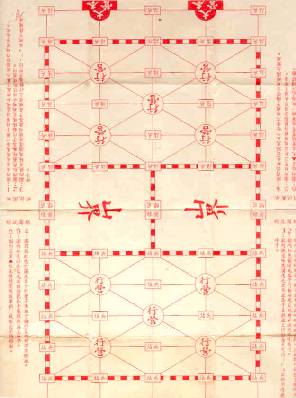
Note the railroads, which are the dotted lines. The circles are called `army camps', and at each side of the board, there are two positions that form the `main camp' of a player.
The pieces
Each player has twenty-five pieces. Pieces cannot be distinguished from each other from their back side - even red and black pieces cannot be distinguished.Most pieces have a rank. Except when noted differently, higher ranked pieces capture lower rank pieces.
Each player has the following `ranked pieces':
- 3 gongbin (soldiers, lowest rank)
- 3 paizhang.
- 3 lienzhang.
- 2 yinzhang.
- 2 tuanzhang.
- 2 luzhang.
- 2 shizhang.
- 1 junzhang.
- 1 sili (general, highest rank.)
Movement rules
Flags and landmines cannot move. All other pieces can move one square across a line. Across the railroads (the dotted lines), pieces can move multiple squares in one turn. However, pieces may not make turn a corner in a turn when moving across a railroad. (In two variants, there is an exception on this for the soldier.)Variant one: Basic army chess
These rules are as given to me by my brother, Maarten Bodlaender. This variant is played by two players without a referee.All the fifty pieces are mixed, and randomly placed on the board. I.e., one cannot see which pieces are red and which pieces are green, in addition to the type of the pieces. The pieces are placed on the positions which have a rectangle or are a main camp position. (If you count, you can see there are exactly 25 of them at each side of the board.)
Each turn, a player either may turn a piece or move a piece. The first piece turned by the first player shows with which color he plays.
You may not enter the square with the flag of the opponent until all his mines are taken. In this variant and the next, soldiers may, when moving across railroads, turn corners.
When moving, you may never move to a position with a piece that is not yet revealed. By moving a piece of higher rank to the position of a lower ranked piece of the opponent, you take that piece. If you move a piece to a position with a higher ranked piece of the opponent, your piece is lost (not a clever move.) If you move a piece to a position with the same piece of the opponent, both pieces disappear.
Missiles are special pieces: they can move like any other piece, and they can take any piece of the opponent except the flag. However, when a missile takes a piece, it is removed from the board itself also.
Landmines cannot move, and there are three variants for taking a bomb:
- Only the lowest ranked piece of a player, still on the board, can take the mine.
- Every moving piece can take a mine.
- Only soldiers may take a mine.
There are two variants of this variant, concerning the rule when this game is won:
- Fast game: a player wins by moving the lowest ranked piece on the square with the flag of the opponent.
- Slow game: bring the flag to the own camp. (Precise details how this is done are missing.)
Variant 2: Referee army chess
This game is played by two players with help of a referee. Except when noted differently, rules are as in variant one.Players place their own pieces in a way, only visible for themselves, at the positions with a rectangle or a main camp at their own side of the board. The flag must be placed in one of the two main camp squares.
A player can try to take a piece of the opponent by moving (following the normal movement rules) a piece to a square that contains a piece of the opponent.) Then, the referee compares the two pieces, without revealing the identities of the two pieces to the players, and then removes the pieces that are taken. The players do not see which piece was of the opponent, whether or not it was taken.
If a player loses his general (sili), then he must show the opponent the position of his flag.
The flag can always be taken. However, missiles may not enter the main camp squares of the opponent.
Winning conditions are as in variant one (I would recommend playing until the flag is taken.)
Variant 3: A second game with referee
The game, as described to me by Richard Tan, differs at a few details. This variant is also played with a referee.In this variant, when a piece moves to a square with a mine, then it, and the mine are destroyed, except for soldiers, which survive moving to a square with a mine (the mine still is destroyed.)
Purpose of the game is to capture the flag. In this variant, missiles can also capture enter the main camp squares of the opponent, and hence capture the flag. Also, pieces can be captured at `camps' (the positions with a circle).
Moving and taking pieces is further as in variant two.
Variant 4: Previous game, but without referee
When no referee is available, variant 3 is also played without a referee. In that case, when a piece tries to capture another piece, the players themselves compare the pieces. As this removes some of the incertainty of the game, this variant is considered to be inferior of the previous one.Written by Hans Bodlaender. Thanks to Richard Tan and Maarten Bodlaender for (translations of) the rules of this game.
WWW page created: September 9, 1999.