Version with tables in html-form
Chess and Role Playing Games (RPGs) seem to have little in common. Ralph Betza, one of the most well-known modern chess variant inventors, invented a chess variant, which is a crossover between a role playing game and chess. In an article in Eteroscacco, the periodical of AISE, issue 69/70, 1995, he describes his game, whose name is abbreviated as WOTN. The game probably is already a few years older, because a shorter description can be found in Pritchard's Encyclopedia of Chess Variants. Below, you find the article from Eteroscacco, repeated here with permission of the author. Could an Italian reader perhaps translate the few Italian words for me?
WotN: the Way of the Knight
Castelli writes, in Eteroscacco 57, `Resta ancora un anello per arrivare ai giorni nostri, il "role- playing", il gioco di ruolo.'So, here's an RPG (role-playing-game) chess variant.
1. Chess
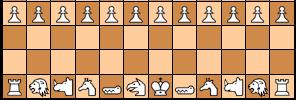
The initial position is the same as Chess, and all the rules of chess apply, except when specified herein.2. Adventurers
Each of the two armies in WotN contains 16 adventurers; all pieces are basically the same type of piece.WotN simulates a single violent encounter between two parties of adventurers; it does not simulate an entire RPG.
3. Attributes
Each adventurer is the same, as stated above. What makes a Knight different from a Pawn is that they have different Attributes.WotN has only two attributes: Experience Level and Alignment.
4. Experience Level
The experience level of a piece is the primary factor that determines what moves it may make on the board.There are 11 possible Experience Levels, from 1 (the lowest), represented by the Pawn, to 11 (the highest), represented by the King.
5. Alignment
In addition to the Experience Level, each piece has another attribute, the Alignment.There are 3 possible alignments: neutral, Knight, Bishop.
At experience level 1, 5, 7, 9, 10, and 11, all Adventurers have a neutral Alignment; at other levels, pieces must be aligned either with the Way of the Knight or with the Way of the Bishop.
6. Improvement
Adventurers improve their Experience Level by one (1) whenever they either:(a) capture an enemy Adventurer whose Experience Level is at least half as great as the level of the capturing pieces; or
(b) Move to a rank on the board, equal to the adventurers level plus 5 (for a White Pawn, that's a6 to h6; for a Black Pawn, that's a3 to h3: the "6th rank".
Improvement is not optional. You can only improve your level by one, no matter how experienced a piece you capture. No partial improvement: if the piece you capture is too inexperienced to improve you, it does you no good at all.
7. Choosing a path
When a piece improves from level 1, 5, or 7, it must choose either the Way of the Knight or the Way of the Bishop.When a piece of level 2 or 3 improves, it must remain on its current Path.
8. Diagram of the Paths
Level Alignment Alignment Alignment
         Knight    Neutral    Bishop
  1        -        Pawn        -
  2       Wfd         -         AD
  3      Knight       -       Bishop
  4        NW         -         DB
  5        -        Rook        -
  6        Nr         -        FLD
  7        -          BN        -
  8        C          -       Queen
  9        -         NrB        -
 10        -         NrR        -
 11        -        King        -
9. List of Ranks
Pawn, Knight, Bishop, Rook, Queen, King: as in Chess.- Wfd
- Wazir plus foreback-Dabbaba; moves in each of
the 6 directions,
{ (0,1), (0,-1), (-1,0), (1,0), (0,2), (0, -2) } (we specify
the directions as (vertical, horizontal, because that is how
they appear in algebraic notation).
In other words, it moves one square only Rookwise in all four directions, and it leaps two squares forward or backward but not sideways.
In other words, a Wfd on e4 could move to e6, e5, e3, e2, d4, f4; and it could move to e6 even if there were something on e5.
- AD
- Alfil plus Dabbaba; leaps to squares to each of 8
directions, { (0,2), ... , (2,0), and (2,2), ..., (-2,-2)}
In other words, it leaps one square in any Rookwise or Bishopwise direction.
Note that it can only ever see one-fourth of the squares on the board.
- NW
- Knight plus Wazir; a single Rookwise move is added
to the standard move of the Knight.
- BD
- Bishop plus Dabbaba; a two-square Rookwise leap
is added to the standard move of the Bishop.
- Nr
- KnightRider; instead of stopping after a single
step, this piece continues on in the same direction. A
familiar piece to the Chess Variant enthusiast, needs no
further introduction.
- FLD
- Ferz plus LongKnight plus Dabbaba; least
directly to 16 different squares of the same color: from e4,
it can reach d7, f7, e6, b5, f5, h5, c4, g4, b3, d3, f3, h3,
e2, d1, f1.
- BN
- Knight plus Bishop.
- C
- Chancellor; Rook plus Knight.
- NrB
- Knightrider plus Bishop.
- NrR
- Knightrider plus Rook.
Note: It is important to the playability of the game that the value of WfD is awfully close to the value of AD, NW to BD, Nr to FLD, considerations will be more important. (It is also important that the value of Wfd is about midway between P and N, and so on).
10. Check and Mate
If your side has only one king, the normal rules of check and mate apply to you.If your side has more than one King, you can ignore check; even if both Kings are attacked, it doesn't matter.
Improving a NrR to a King is a valid answer to check.
11. Sample game and notation
1. e2-e4, e7-e52. Ng1-f3 Nb8-c6
3. d2-d4, Nc6:d4?!
Not 2 ... e5:d4/AD? (improving from Pawn e to AD on d4), 4. Nf3:d4/NW, Nc6:d4/NW Qd1:d4/NrB; the result would be the same, except that White's piece on d4 would be Improved. Of course 3. ... d6 or 3. ... d!? are likely to be better.
4. Nf3:d4/NW, e5:d4/WfD
5. Qd1:d4, Qd8-f6!?
6. e4-e5, Qf6-b6
7. Bc1-e3, Ng8-e7!
Naturally, White didn't want to play 7. D:d6/Nrb, a7:b6/AD and Improve his foe. After 7. Be3, 7. ... d7-d6? 8. Nb1-c3!, d6:e/something?? 9. Bf1-b5 +, and whatever is on e5 can't capture d4. But now, after 7.Be3, Ne7, Black threatens Nf5 and (in some cases) Q:b2. Perhaps 8. Qc3 is forced.
8. Bf1-c4?, Ne7-f5
9. Qd4-d5, Nf5:e3/NW!
If 9. ... Qb6-e6, 10. Nb1-c3 gives White a comfortable lead in development.
10. Qd5:f7+, Ke8-d8
11. f2:e3/AD, Qb6:b2
Presumably, 11. ... Qb6:e3+ equalises.
12. Ade3-c3, Bf8-b4
13. Ke1-e2, Bd4:c3/BD
14. Nb1:c3/NW, Qb2:c3/NrB +
15. Ke2-e3, NrBc3:e5
White hasn't resigned because his material deficit is `only' a couple of Pawns and an Improvement; perhaps superior development will help. 15. Ke3 was the only move to avoid check.
Now that all of White's pieces defend each other, the forking power of the NrB is useless; the fact that 16. NrB:f7 17. B:f7/BD Improves White makes it easier to keep the Queen on the board for attacking purposes.
Perhaps 15. ... NrB:e5 is a mistake; too greedy, opening lines ...
16. Ra1-e1, c7-c6 ?!
17. Rf1-h1 !!, d7-d6
If 17. ... d5, 18 Qf8 + R:f8/xx 19. R:f8/FLD +, Ke8 20. FLDf8:e5/BN d:c4/xx 21. Bne5:g7 + and wins. This is a nice combination.
18. Ke3-d2, NrBe5-g6
The NrB on g6 defends e7.
19. Qd7:g7!
If 19. Bd3, NrBf6-g5 + may hold; but now 20. Bd3 is threatened, and 19. ... Bf5 is no help (20. R:f5!).
19. ..., Bc8-d7
20. Bc4-d3, NrBg6-h4 +
21. Kd2-c1, Kd8-c7
22. Re1-e7, Rh8-d8
23. Rf1-f7, Resigns
12. Summary
The idea that minor captures do not Improve the Experience Level of a piece is adapted from role-playing-games. This idea is excellent; compare WotN with Absorption Chess to see how it helps.The `promotion ladder' was purposefully designed so that a minor piece capturing a Pawn does not Improve, and a Queen capturing a minor piece does not improve.
The fact that pieces may become more powerful by capturing tends to keep more pieces on the board, because whoever initiates a `capture-recapture' sequence loses by doing so. This should lead to short games with dramatic conclusions.
Providing two Paths is a good idea. Perhaps 3 complete Paths should be provided, with the rule that whenever a piece Improves, it may either keep to the same Path or change to/from the neutral Path.
Thus, a Knight couldn't promote to BD, but it could promote to the neutral piece of the same rank.
Level Alignment Alignment Alignment
         Knight    Neutral    Bishop
  1        -        Pawn        -
  2       Wfd         -         AD
  3      Knight       -       Bishop
  4        NW        KD         DB
  5        NWfD     Rook       FAD
  6        Nr       KAD        FLD
  7        NAD       BN        BL
  8        C          -       Queen
  9        -         NrB        -
 10        -         NrR        -
 11        -        King        -
There's a more filled-in chart. No example game for this variant, though it's probably the better one
(but might be too complex).
What I like about it is the choice of promotions as you capture in the middle of a combination. Might be hard to keep your thinking error-free, though ...
The above text is written by Ralph Betza, and copied here with his permission.
WWW page created: October 16, 1995. Last modified: February 16, 1996.