White and Black Chess
In the March/April 1998 issue of Nostalgia, the bulletin of NOST, John McCallion describes this variant, which he attributes to V. R. Parton.Rules
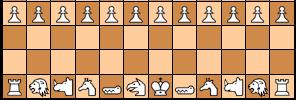
The game is played using the rules and setup of orthodox chess, but now, each turn consists of two moves. First, the player moves a piece that stands on a white square, and then the player moves a unit that stands on a black square. It is the color of the square that the piece is on before it is moved that counts. Castling is always possible either as first or as second move of a turn. It is allowed to move the same piece twice, if the colors of the squares it goes to permit it. For instance, white can start the game by moving Nb1-c3; Nc3-e5 (not necessarily a good move, however.)When the first move of a turn gives check, the players turn is ended and he does not get his second move. Check must be parried with the first move of the turn - however, a check can be removed by moving a piece from a black square, in which case the first move (from a white square) is lost.
Improvement
McCallion and Ernest Park played that white has only a single move (from either a white or black square) on his first turn. Such a rule (which is more common in similar chess variants) helps to reduce the opening advantage of white, and hence is recommended.Black & White chess
McCallion gives in his article a second variant, that is a small modification of White and Black chess. In this variant, a player first moves a piece from a white square, and then a piece from a black square. Knights may not move to g4 and g5 (to make too easy early attacks by the knights impossible.) All other rules are as in White & Black chess.Written by Hans Bodlaender.
WWW page created: March 23, 1998.