Renniassance Chess
Renniassance Chess was invented on April 1, 1980 by Eric V. Greenwood.
Correctly spelled, the game would be called Renaissance Chess; Greenwood, however, thought it would be fun to deliberately misspell it as Renniassance. The game is also commonly referred to as Rennchess, the name it goes by on Richard's PBeM Server.
Rules
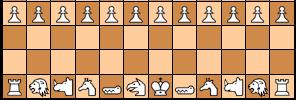
Renniassance Chess is played on 12x10 board. The setup is as follows.
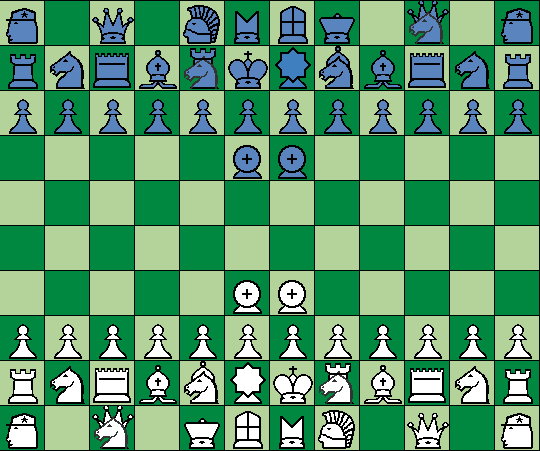
The Pieces
All pieces from Orthodox Chess play a role in this game, with several new pieces with challenging moves and interesting interactions.

|
K - King: Moves one square in any direction. The K may not move onto a square attacked by an enemy piece. If an enemy piece attacks the K, the K must be out of check at the end of his next move. |

|
Q - Queen: Moves any number of squares in any direction. The Q may not jump over other pieces. |

|
R - Rook: Moves any number of squares horizontally or vertically. The R may not jump over other pieces. |

|
B - Bishop: Moves any number of squares diagonally. The B may not jump over other pieces. Note that the B can not change the color of squares on which it moves. |

|
H - Horse: Moves one square straight and then one diagonally away from the starting square. The H may leap over other pieces. Its move is the same as the knight in chess. Note that an H starting its move on a dark-colored square will end its move on a light-colored square and vice versa. |

|
P - Pawn: Moves forward one square. On its first move, the P may move one or two squares. The P's capture is different from its move, it captures by moving diagonally forward one square. When a P reaches the last rank, it promotes to any piece of the player owning the pawn that has been captured by his opponent. Also, if a Pawn reaches the next-to-last rank it may promote to Fox (see below) only. There is no limit to the number of Foxes a player may obtain through P promotion. |

|
F - Fox: Moves one square horizontally or vertically. If the F reaches the last rank it has the option of promoting to guard (see below). There is no limit to the number of Guards a player may obtain through F promotion. |

|
U - Guard: Moves one square in any direction. Unlike the K, however, the U is not limited by threats from the opponent's pieces. |

|
E - Page: Moves as either a Horse or a Guard. |

|
S - Squire: Moves one or two squares in any direction. The S may jump over other pieces. |

|
C - Castle: Moves as a Horse, or moves exactly two square in
any direction. The C may jump over other pieces.
|

|
G - General: Moves two squares straight and one diagonally away from the staring square. The G may jump over other pieces. Note that the G can not change the color of square on which it moves. |

|
A - Archbishop: moves as either Bishop or Horse. |

|
N - Nobleman: moves as either Rook or Horse. |

|
I - Prince: moves as either Queen or Horse. |

|
D - Duke: moves one square straight and any # diagonally; or any # diagonally and one straight. May not jump or move to an adjacent square. |

|
V - Cavalier: moves one square diagonally and any # straight; or any # straight and one diagonally. Also may not jump or move to an adjacent square. |
Additional rules
There is no castling.
There is en passant allowed. (if a pawn moves two squares (only allowed on its first move): it may be captured by an opposing pawn attacking the square the pawn "skipped" over. The attacking pawn moves into the "skipped" square and the two-move pawn is captured just as if it had only moved one square. This is allowed ONLY the turn directly after the double-move takes place.)
Object of the game is to mate the King of the opponent; other rules are as in Orthodox Chess.
Variants
There are a number of variants of Renniassance Chess.
- On a 12 by 10 board: the original game.
- On a 12 by 12 board: all pieces one more row back. gives time to set up before having to respond to threats. The 12 by 12 board for this game was an idea of LeLand Lankford.
- On a 12 by 12 board with the setup of the 12 by 10 board (i.e., the last rows at each side of the board are empty): interesting hybrid allowing easy flank-to-flank redeployment behind the lines.
- On a 12 by 14 board: totally untried experimental! set up as 12x12; lots and lots of redeployment space! Possibly too much space. note piece values can change as the board expands (and contracts).
- Timur's Pawns- (not included as "official", due to possible set construction problems, but strongly recommended!)
- All pawns promote differently, as in Timur's Chess: (White's third rank, Left to right: Pawn of Pawns, Duke's Pawn, Prince's pawn, Nobleman's Pawn, Castle's Pawn, Squire's Pawn, Page's Pawn, Rook's Pawn, Archbishop's Pawn, Queen's Pawn, Cavalier's pawn, King's Pawn. Black's pawns are set up the same way, so that his King's Pawn opposes the PoP, the Cavalier Pawn is across from the Duke's Pawn, and so on.
- All pawns promote on the Opponent's piece row or beyond (clarification: the row his King, Guard, Rook, etc, start on, or on any row farther away from the Promoter player)
- When promoted, the King's Pawn becomes a second Monarch (the Prime Minister); BOTH Kings must now be mated before a victory occurs. The new King may move into check if so desired; it plays as a Guard until the first king falls. When the original King is mated, it stays on the board until the mating player's next move; then it is picked up by the mating player, and he then moves normally. The delay in removal represents the transfer of power to the other King, and allows the new King to move out of check if he's in it!
- The Pawn of Pawns is similar to Timur's, but with these differences:
- upon reaching the promotion zone, the pawn becomes Immune to capture.
- whenever the opponent has a piece that is trapped, or 2 pieces in a Fork position (as pawns capture), or can give a check to the enemy king, or can be placed so as to move into an opponent's corner square on the next move, or to capture into the opponents corner, the PoP can be placed to do that thing.
- If the PoP reaches the promotion zone again, (Must move as a pawn at least once), It is placed anywhere on the original pawn row. It gains the ability to take a double step at any point in its move. If the PoP makes it to the promotion zone a third time, It becomes a Mercenary King: moves as either Guard or Castle. The Mercenary King may also assume the role (and move) of the original King if he is mated.
- Foxes promote to Guards on the opponent's piece rank, or past.
- Horses, if they reach the opponent's corner square, promote to Pages.
- If a player has less than 7 pieces (not counting King[s] and pawns) remaining, and he can get his bishop to a corner square, the piece may promote to Castle.
- If a player has 7 pieces remaining, not counting King[s] or Pawns, (but counting the Mercenary, if active), and can get his General to a corner square, the piece promotes to Squire.
- If there are 7 pieces remaining, not including the King[s], and the Duke reaches a corner square, It gains the move of the Guard.
- If there are 7 pieces remaining, (not counting the Mercenary only) and the Cavalier reaches a corner square, It gains the ability to move as a Guard.
- If checked, once per game, a King may exchange positions with any allied piece on the board. This applies to the Prime Minister and the Mercenary also if they have assumed the throne( for a possible 3 switches per game!) Bishops and Generals may switch colors when swapped; pawns may end up on the first rank(in which case they may move double until reaching the rank past their original starting row), or the last (they MUST promote the next available move-available being defined as whenever all Kings [not just the original] are not attacked. they are NOT immune to capture while waiting for promotion.)
- If a King (reigning) can move into the opposing corners, the game is drawn, OR, if the player chooses, he can exchange his King for the Prime Minister or the Mercenary king and continue the game.
Inspiration is from Tamerlane chess (also called Timur's Chess.)
A comment of John Brown
In an email of John Brown (author of the book Meta Chess) to Eric Greenwood, John Brown made the following comments on Renniassance chess:My trip to Dallas lasted longer than anticipated. I did, however, have the oportunity to play Renniassance Chess several times and found it quite interesting. The game does indeed have many features in common with Timur's Chess. It differs, though, in the degree of raw 'board power' available to each player. In fact, the Renniassance Chess pieces have collectively about three times as much power as that of most of the games that I regularly play.
This is not necessarily undesirable -- it just forces a different strategy. With my one partner, I found that the winner was most often the player who could orchestrate his moves so that each piece was protected by a lesser piece, thus making captures unprofitable. In fact, we became so fascinated with this new strategy, that my partner has vowed to explore its possibilities by designing other games that favor this style of play.
On the down side, I would say that a game of this intensity is not something one might play for relaxation. I tended to play best (and enjoy it more) when I was hyped up and high on caffeen. But hey -- life must have its little thrills! Perhaps you should add a disclaimer to your site: Not for the Weak of Heart :-)
In another email, he wrote:
... Bear in mind that mine and Mr. Havel's style of play is one that is pecular to the synergy of our personalities. With so much power and mobility on the board, we find it difficult to look acurately more than one or two moves ahead. To compensate for these unknowns, we "insure" our pieces by moving them in a lock step of mutual coverage. Other players, more familiar with the game (or having greater "foresight") might employ a different strategy. Moreover, our styles may very well mutate as we become more accustomed to the game.
This game can be played via email on Richard's Play-By-eMail Server.
Written by Leland Lankford, Eric V. Greenwood and John Brown; editing by Hans Bodlaender. Original Renniassance page on the World Wide Web: http://home1.gte.net/thecav/rchess.htm. (No longer available.) Additional playtesters: Bob Williams and Bill Simons. Some minor editoral changes made by Hans Bodlaender.
WWW page created: 1997-07-01.
WWW page updated: 2021-05-15.
March 2000: D. Howe added link to Richard's Play-By-eMail Server.
July 2002: Ben Good added graphics and note on name.