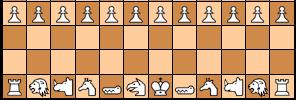
Mideast Chess
Mideast Chess was described late 1971/early 1972 by John Mantle Green, wro wrote to John Gollon (author of Chess Variants: Ancient, Regional, and Modern). Gollon send parts of a draft of a followup of his book to Eric Greenwood in 1976; Eric communicated this information to me in 1997.Green named this variant Mideast Chess, because some of its pieces resemble pieces from Tamerlane Chess. Green wrote that Mideast chess was a relatively local variation of California, and characterized the game as probably a local experiment that players found interesting.
Many of the names of the pieces are as given to them by Edward Falkener in its book Games Ancient and Oriental and How to Play them. (A Dover reprint of 1961 may still be available?) Falkener renamed the pieces in his book, and this game follows the naming of the pieces from Falkener.
Rules
Mideast chess is played by two players on a ten by ten board. Each player has in addition to a normal set of pieces, two courtiers, two chevaliers, two castles, two cavaliers, and two extra pawns.The starting setup is as follows:
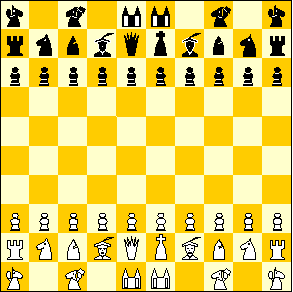 White:
King f2; Queen e2; Rook a2, j2; Knight b2, i2; Bishop c2, h2; Cavalier
d2, g2; Courtier a1; j1; Chevalier c1, h1; Castle e1, f1; Pawn a3, b3,
c3, d3, e3, f3, g3, h3, i3, j3.
Black:
King f9; Queen e9; Rook a9, j9; Knight b9, i9; Bishop c9, h9; Cavalier
d9, g9; Courtier a10; j10; Chevalier c10, h10; Castle e10, f10; Pawn a8, b8,
c8, d8, e8, f8, g8, h8, i8, j8.
Movement of the pieces
The king, queen, rook, knight, bishop, and pawn move as in orthodox chess, but pawns can also promote (when they reach the last row) to cavalier, courtier, chevalier, or castle, as well as to queen, rook, knight, or bishop. There is no castling.The castle moves as a knight, or can jump to any square that is horizontally, vertically, or diagonally two squares away. So, a castle on d4 can jump to b2, b3, b4, b5, b6, c2, c6, d2, d6, e2, e6, f2, f3, f4, f5, or f6.
The chevalier has a kind of `streched knights leap': it jumps two squares straight and one diagonally. So, a chevalier on a1 can jump to b4 or to d2.
The courtier has another kind of streched knights leap: it jumps one square straight and two diagonally, so for instance from a1 to c4 or to d3.
The cavalier first moves one square diagonally, and then an arbitrary number of squares horizontally or vertically, or it moves one square horizontally or vertically, and then an arbitrary number of squares diagonally. The cavalier may not jump: all squares passed over must be empty. The cavalier may not move to an adjacent square.
Other rules are as in orthodox chess.
Suggested variant rules
Gollon suggested to allow pawns to make an initial triple step, extending the en passant rule to all squares passed by by the pawn. Also, Gollon suggested to allow castling, where the king always moves three squares when castling; other castling rules as in orthodox chess.Greenwood's variant
Eric Greenwood suggested a variant, and wrote the following.White: pawns now on d4, e4, f4, and g4, W/ corresponding for Black. These pawns do not double jump on the first move. On d3: Vizier-1 square horizontally and vertically. On e3: Silver-1 square diagonally or forward. On f3: Gold-1 square diagonally forward or vertically or horizontally. On g3: Firzan- 1 square diagonally OR BACKWARDS {My modification}. Upon reaching the back rank, all these pieces promote to Guard-one square any direction.
These modifications make for a slightly more strategic level game, and help cut down on the immediate forkings of the COurtiers and the CHevaliers-note the CHevalier's move is the same as the General in Renniassance.
Written by Hans Bodlaender and Eric Greenwood, based upon information from a manuscript of John Gollon from 1976.
WWW page created: October 7, 1997.