Quintessential chess
A chess variant on 84 squares featuring the quintessence.About
I found the quintessence while thinking hard about crooked nightriders. Unlike the other four species of crooked nightriders which are known as Spiralspringer and Diagonalspiralspringer to problemists, the fifth element seems to be undiscovered before. It was first published to my knowledge in my study game Nachtmahr.This is the first game featuring the quintessence. Since it happens to be on 84 squares, this is my second entry to the 84 squares contest.
The Board
The board is a 10 x 10 checkered board with 2 x 2 squares on each corner removed. As usual, the lower left square is a dark square and Leeloos are on fields of their own colour. Leapers may jump over the missing fields in the corners, but riders can't ride thru.The pieces
Each side has 20 pieces, 10 pawns, one king and 9 figures of 5 different species.The pawns (Bauern) [P]
The pawns start on the third rank. They can move one or two steps in forward direction without capturing and capture one step diagonally. Unlike FIDE chess, the pawns can use their double move at any time. The only exception is, that they may not step to their promotion rank using a double move. Capturing en passant is possible. Unlike in FIDE chess, any piece can capture a pawn en passant. En passant capture is no longer a pawn's priviledge. When a piece moves to a square, where it can capture en passant, it does so automatically. It cannot move there without capturing.Bockspringen
If two pawns of the same colour are forming a double pawn, the second pawn may jump over the first one in forward direction, provided that the target square is empty. A jumping pawn may be captured en passant, resulting in the capture of two pawns in one strike. Taking both pawns is obligatory in this case. It is forbidden to jump into the last rank for promotion. Bockspringen is not available for the last pawn of a triple pawn.Pawn promotion
Pawns promote to any of centurion, quintessence, janus, dragon horse or leeloo reaching a square from which forward movement is impossible. White pawns promote on the fields a8, b8, i8, j8, c10 -- h10.The centurion (Zenturio) [C]
The centurions start on squares c1 and h1. They have the combined moves of Alfil, Knight and Dabbabah. The name centurion comes from archchess, published in 1683. The piece was forgotten and rediscovered as squirrel, a name sounding too harmless for this strong piece. In the starting setup of quintessential chess, the two centurions protect all the pawns. (I.e., the centurion can jump two squares in any horizontal, vertical, diagonal, or knight-direction. Editor.)The quintessence (Quintessence) [Q]
The quintessence start on d1 and g1. The quintessence can take consecutive knight moves, changing its direction in a 90 degrees zig-zag pattern. On an empty board, it can move d1 -- c3 -- e4 -- d6 -- f7 -- e9 -- g10.The king (König) [K]
The king starts on e1 and moves like a FIDE chess king. It has the possibility to castle with a centurion under the usual circumstances (king and respective centurion have not yet moved, the king is not in check, not moving thru check, not moving into check). To castle, the king jumps two spaces towards the centurion, and the centurion jumps over the king. Thus, the postions after castling are as follows: 0-0 : Kc1 Cd1; 0-0-0: Kg1 Cf1.The Leeloo [L]
The leeloo, the quintessential queen, starts on f1. It has the combined moves of rook and quintessence. Leeloo is the fifth element in Luc Bresson's film, played by Mila Jovovich.The janus (Janus) [J]
The two janusses start on e2 and f2. They have the combined moves of bishop and knight. I prefer to call this piece janus, since the wordplay behind the name cardinal doesn't work in languages where the bishop is called 'runner' or 'fool'.The dragon horse (Drachenpferd) [D]
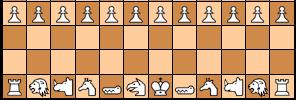
The two dragon horses start on d2 and g2. They have the combined moves of bishop and wazir.Starting position:
White: Cc1, Ch1, Qd1, Qg1, Ke1, Lf1, Dd2, Dg2, Je2, Jf2, pawns: a3..j3
Black: Cc10, Ch10, Qd10, Qg10, Ke10, Lf10, Dd9, Dg9, Je9, Jf9, pawns: a8..j8
The aim of the game
The aim of the game is the checkmate of the enemy king. The usual FIDE rules apply, with the following modification:The 50 moves rule is replaced by the following 100 moves rule:
A game is a draw, if for 100 full moves (both turns) no irreversible move has occurred. Irreversible moves are captures, pawn moves and castling.
Note also that capturing en passant is available for all pieces, not only for the pawns.
Notes:
The quintessence wants a larger board than 8 times 8. Thinking about the 10 times 10 board with removed corners it looked like a perfect stage for the quintessence.To keep a cheeslike density of power, 10 pawns and 9 pieces plus a king are adequate. The pieces drafted are rather balanced in power, therefore there are lots of possible exchanges. There aren't any colourbound pieces, nor any colourchanging pieces in this game. The Leeloos are outstanding superpowers, significantly stronger than standard chess queens. The Leeloos are the only pieces with rookwise movement, making quintessential chess very different from the FIDE game with its rook lines. Watch diagonals and quintagonals, the lines of movement of the quintessence and Leeloo.
Beware of the fast pawns! The rules from FIDE chess endgames do no longer apply. The pawns are more vulnerable for their velocity. The quintessence is the weakest figure in the game, try to develop it first. All figures except the Leeloo are of comparable strength, so you can trade a weaker piece for a positional advantage and you have lots of tactical choices. The Janus and the Leeloo often can mate without a supporting piece, watch them carefully.
In the initial setup, take care of the squares c2/c9: They are only protected once, and the quintessence can reach them easily to checkmate the king.
References:
Written by Jörg Knappen.