Herb garden chess
William Overington
31 July 2002
This is an entry for the 84 spaces contest.This game uses the pieces of ordinary chess and some extra pieces. Each side has a complement of the pieces of ordinary chess plus four extra pawns plus two champions and two centaurs.
The champion has the combined moves of a rook and a knight.
The centaur has the combined moves of a bishop and a knight.
Herb garden chess is based upon Carrera's chess. It is thought of as being played in a herb garden and perhaps depicted being so played in a 17th Century style painting which depicts both the chess board and various herb plants. Perhaps such a picture could be embroidered in a tapestry.
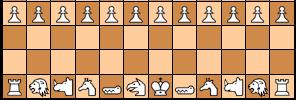
The game is played on a chequered board which is 12 squares wide by 7 squares deep.
Each side has a square of its own colour in the right hand corner.
The starting layout is as follows, using the following notation.
Each queen starts upon her own colour of square. This, combined with the seven square depth of the board, counterchanges the central area of the game as regards ordinary chess.
Pawns may move two squares at their first move as in ordinary chess.
The en passant rule is as for ordinary chess.
Castling is permitted by moving the king two steps towards the rook and then moving the rook to the square beyond the king.
Championing is permitted by moving the king two steps towards the champion and then moving the champion to the square beyond the king.
Centauring is permitted by moving the king two steps towards the centaur and then moving the centaur to the square beyond the king.
Castling, championing and centauring may take place to either the king's side or the queen's side, provided always that there are only empty spaces between the king and the other piece which participates in the move.
Each side may only use castling, championing or centauring once in any one game and provided that the king has not been checked at any previous time in that game and provided that both the king and the participating piece have not moved previously during the game.
In game nomenclature, the following are used.
O - O      King's side castling
O - O - O  Queen's side castling
H - H      King's side championing
H - H - H  Queen's side championing
E - E      King's side centauring
E - E - E  Queen's side centauring
Pawn promotion is to queen, champion or centaur at the choice of the player.
A player wins by checkmating the opponent's king. A stalemate is a draw.
The inspiration for the game is that I like historical games and so I have tried to devise a game which would seem to have the style to have been played in the 17th Century in the times of D. Pietro Carrera. Accordingly, I have used the naming of the pieces in the historical form used by D. Pietro Carrera.
Written by William Overington.