Scheherazade
Among the most frequently used variant chess pieces are the variant "queens," the chancellor (rook+knight) and cardinal (bishop+knight). It is well-known that each of these combinations is more valuable than the sum of its parts, at least partially due to the increased power and concentrated attacks of the combination piece. In Scheherazade, players begin with no queen-caliber pieces, but instead a variety of mid range pieces, and during the course of the game, may combine these pieces to choose their "queens."Play is as in FIDE chess, except as noted below.
Object:
The winner is the first player to either checkmate, bare, or stalemate the opposing king. In the case of bare king, the historical rule applies -- if the bared king can immediately bare the opponent, it is a draw. Draws are also by repetition or agreement.
Board and initial setup:

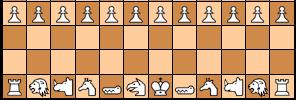
Sheherazade is played on a 10x10 board. Initially, the pieces are set up as shown above.
Pieces:
Knight, Bishop, Rook: These are unchanged from FIDE chess.King: As in FIDE chess, moves one square in any direction. However, castling is clearly impossible from the initial setup. Instead, if the king has never moved and it is not in check, it may move rookwise along the second rank. It may not pass over attacked squares, and may not capture with this move.
Pawn: Moves and captures as in FIDE chess. En passant is identical. Promotion is a bit different. A pawn advancing to the ninth rank optionally promotes to any basic piece (any piece other than king or pawn that a player began the game with). A pawn advancing to the tenth rank must promote to any of the "queens" (any piece that combines the powers of two of the basic pieces).
Hussar: FC in Betza's Funny Notation. Represented by the inverted knight above. Moves diagonally one square, or moves two orthogonally and one diagnoally, leaping over intervening squares (camel). This piece is colorbound.
Onager: FDD in Betza's Funny Notation. Represented by the inverted rook above. Moves diagonally one square, or runs along dababba-lines (every other square rookwise). This piece is also colorbound.
Spearman: WA is Betza's Funny Notation. Represented by the inverted bishop above. Moves two diagonally, leaping over the intervening square, or one orthogonally.
Queens:
When one of the basic pieces (those other than pawns, the king, and "queens") could move to a square already occupied by another friendly basic piece, and that square is in front of the player's third rank (where the pawns start), that move can be made. The resulting two basic pieces sharing the same square merge into a single "queen." The new "queen" can make any move either of the pieces that made it could make.Errata: A piece can "merge" with another piece of the same type, resulting in the effective suicide of one of the two pieces involved. The surviving piece, however, is not a "queen," and can later merge with another basic piece, which real "queens" cannot.
Notation: Write the merging move as #. Denote queens by using the abbreviation letters of the pieces that made them. For example, if the white rook on a4 moves to merge with the white hussar on f4, write Ra4#f4. The resulting piece would be abbreviated RH.
Strategy and value of pieces:
Approximate piece values (in pawns):Knight, Spearman: 3
Bishop: 3.5 - 4
Hussar, Onager: 4.5 (the onager is a bit stronger in the beginning and early midgame, but as the game opens up, pieces learn to hide in the onager's blind spots, while the hussar's awesome forking power overcomes its colorblindness until the very end, and so the hussar is the stronger of the two later)
Rook: 5.5 - 6.5
Compound pieces: There are 15 possibilities, and they're difficult to evaluate. If two pieces have no overlaps in their moves, they are generally slightly more powerful combined than separate (by about 10% or so). Combining overlapping pieces is mostly not worthwhile. The best combinations are often those that relieve the colorblindness of one of their components.
Openings: The same general principles of center control and tempo from FIDE chess apply to Sheherazade. I've made an effort to keep some of the specific tactical battles of the FIDE opening in the game: pawns face off with four intervening squares, and the knights are in the same relative positions.
New pieces:
Hussar: The hussar can move to up to 12 spaces, 6 of them in
front. This supreme forking power (particularly when merged with the
knight's) is good for seizing and maintaining initiative.
Onager: Its dababba-running power makes it harder to block than the rook. Its colorblindness makes it easier to dodge. In the opening, they are powerful, but this fades. Consider pairing any surviving ones with non-colorblind pieces towards the endgame.
Spearman: It is slow and can be awkward to develop. Its wazir-move, however, makes it well-suited for either fortifying or attacking pawn chains. Its relative weakness compared to other pieces makes it even more useful in this role.
This variant is an entry in the 1999 Large Variant contest.
Written by Robert Shimmin.
WWW page created: April 30, 1999.