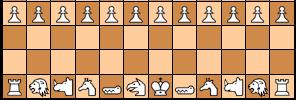
Basic information about Knightmate
Knightmate is the same as Regular Chess except that on e1 you place a White Knight, on e8 a Black Knight, on b1 and g1 White Kings, and on b8 and g8 Black Kings. Only the Knights are "royal" (checkable and checkmateable). Kings are NON-royal."Kings" are just ordinary pieces. They move like Kings, but are NOT checked or checkmated. They're just pieces.
Knights move like Knights but in this game they're the royal pieces to be checkmated. All the rules are the same as regular chess, except as noted here. In castling the Knight makes the King's double-jump, not a Knight move, so the result of castling is the same as in regular chess.
The initial position is as follows:
        ----------------------------
        |  r  k  b  q  n  b  k  r  |
        |  p  p  p  p  p  p  p  p  |
        |  -  -  -  -  -  -  -  -  |
        |  -  -  -  -  -  -  -  -  |
        |  -  -  -  -  -  -  -  -  |
        |  -  -  -  -  -  -  -  -  |
        |  P  P  P  P  P  P  P  P  |
        |  R  K  B  Q  N  B  K  R  |
        ----------------------------
Knightmate shouldn't be viewed as an attempt to replace Regular
Chess. It's just one of many possible variations of chess. But it
has interesting dynamics different from regular chess.
Knightmate was invented in the early 1970s by Bruce Zimov. Some Knightmate tournaments have been played in the American postal chess organization NOSTS, and in the Italian chess variants organization.
Some nuances about the rules
As in regular chess, the royal Knight can't castle when in check. But when it "moves" out of check, that move is (by definition) a leap, since all knight moves are "leaps." The other two ways of countering a check in regular chess can also be done in this game: capturing the checking piece, or blocking that checking piece's attack line.Two royal Knights cannot attack, or check, each other, just as in regular chess two royal kings can't check each other.
Don't forget that kings are NON-royal! That is, they're just pieces that MOVE like kings. But if they move to a square adjacent to a royal Knight, then they give check to the royal piece (Knight).
One more note about castling: All the same rules apply, including the squares the pieces wind up on. That may seem a bit strange for a royal Knight, but it's the easiest way to handle the matter. So in kingside castling, the royal Knight winds up on the g-file; and in queenside castling, the royal Knight goes to the c-file, just like regular chess.
See also:
Written by David Moeser.
WWW page created: July 17, 1997.