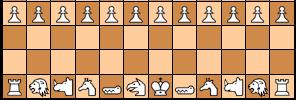
The Duke of Rutland's Chess
This game was invented by John, third Duke of Rutland (from England), in 1747. The game was most propagated by Sir Abraham Janssen, and it enjoyed some popularity in the years after its invention till his death in 1763. Sir Abraham Janssen taught the game to Philidor (by far the strongest chess player of that time), who played this game, offering soon other good chess players a knights odd and still beating them.
Rules
The game is played on a checkered board with 10 rows and 14 columns. The left corners at each players side are dark colored. In addition to the normal pieces of a chess game, a player has two crowned rooks, a concubine, one additional knight, two additional bishops and six additional pawns. The opening setup is as follows: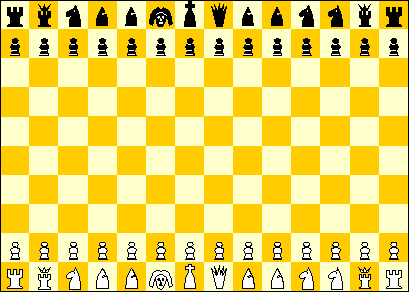
King, Queen, Rook, Knight, and Bishop move as in orthodox chess. The castling rule is unknown. Gollon advises readers to invent one themselves; play e.g., with the rule that the king moves always four squares in the direction of a rook (the rook jumping over the king to the nearby square), under the usual conditions of castling; or play the game without castling
The concubine has the combined moves of rook and knight. The crowned rook can move as a rook, or can go one square diagonally.
Pawns may make an initial double step, but also an initial triple step, i.e., a white pawn on e2 can move to e3, e4, or e5. On squares passed over, the pawn can be taken en passant. When reaching the last row, the pawn promotes to a queen, concubine, rook, crowned rook, bishop or knight to the owning players choice.
A player wins by mating the king. A player that stalemates his opponent loses the game (as was usual in normal chess during that time in England - a punishment for the carelessness of putting ones opponent in stalemate)!
Play It!
Use Zillions of Games to play this game! If you have Zillions of Games installed, you can download this game and play it.Comment
Eric Greenwood comments: This is one of the games I have enjoyed most!Written by Hans Bodlaender, based upon material written by John Gollon, sent to Eric Greenwood in 1976, and sent to me by Eric in 1997.
WWW page created: July 16, 1997. Last modified: July 23, 2003.