Carrera's Chess
Historical Sources
In 1617, D. Pietro Carrera published a book called Il Gioco de gli Scacchi, which is Italian for The Game of Chess.
And in a chapter called Del gioco nuovo,
which means new game
and begins on page 525, he described a Chess variant that introduced two new pieces. He called these pieces Campione and Centauro, which translate to Champion and Centaur in English. He described the Campione as a Roccocavallo, a piece that combines the movement of the Rook and the Knight, and he described the Centauro as an Alfincavallo, a piece that combines the movement of the Bishop and the Knight. Here is a scan of the diagram he published for this game:
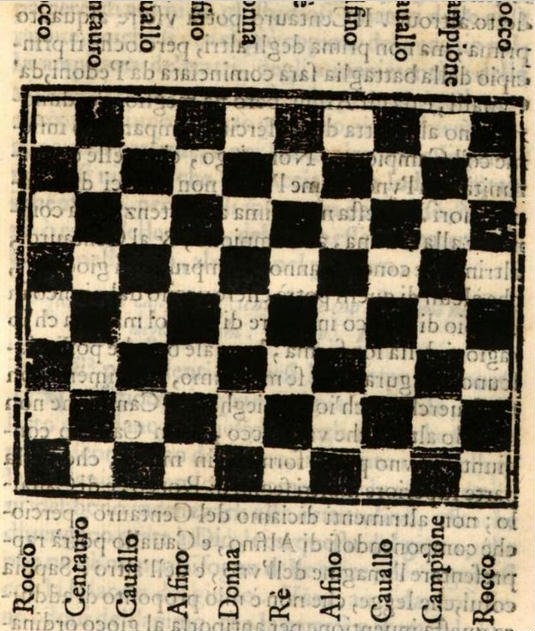
As the diagram illustrates, the game is played on a 10x8 checkered board with a light square in the right corner. The piece names are in Italian, and many are similar to English words related to the pieces. Rocco is similar enough to Rook, Cavallo (related to cavalry or cavalier) means Knight, Alfino (similar to Alfil, an earlier name for the Bishop and its predecessor) means Bishop, Donna means Queen, and Rè (related to regal or regent) means King. In the typeset used for this book, both v and u look like u, and between Cavallo and Centauro, it is a matter of figuring out which spelling gives an actual Italian word.
Since I don't know Italian, that is about all I can pick up from the text. Although I can copy the text into a translator, it doesn't help much, because its archaic typeset and the bleedthrough of ink from one page to another impede character recognition, and even where character recognition isn't a problem, it sometimes leaves words untranslated or translates them incorrectly. Although I have found the English translation by W. Lewis, called A Treatise on the Game of Chess, this translation has omitted the section on Carrera's new game. If an Italian-speaking reader could translate the relevant text, that would be very helpful. Until then, I will rely mainly on English sources.
The earliest known mention of this game in English is in an 1804 book by Thomas Pruen called An Introduction to the History and Study of Chess. He writes,
Carrera invented two new pieces, to be added to the eight original chess-men. That which he calls campione is placed between the king's knight and castle: its move is both that of the castle and of the knight. The other, named centaur, between the queen's knight and castle, has the move of the bishop and knight united. Each of these pieces has its pawn, and, of course, the board must contain two more squares on each side, which will augment their number to eighty. This invention appears to have died with the inventor. (pp. 42-3)
The game is also mentioned in 1889 by Ben Foster in a book called Chancellor Chess, or The New Game of Chess. He writes,
Carrera in 1617 inserted two new pieces, a Campione, having the moves of rook and knight, to be placed between the king's rook and the king's knight and a centaur, combining the moves of bishop and knight placed between the queen's rook and the queen's knight on a board 10x8 squares. (p. 5)
In The History of Chess (1913), H.J.R. Murray writes in reference to Carrera,
In his last book he describes a new variety of chess of his own invention on a 10 x 8 board, with four extra pieces on each side, viz., two Pawns, a Centauro (b1, b8) with the moves of Rook and Knight, and a Campione with the moves of Bishop and Knight. The game never got beyond the book stage.(Kindle Loc 17107)
Although Murray gets the positions of the Centuaro and Campione correct, he switches their descriptions. As Pruen and Foster both mentioned in the previous century, and as my own examination of the Italian indicates, the Centaur moves as a Bishop or Knight, and the Champion moves as a Rook or Knight.
Short of reading the original Italian, which could be helpful, it may be assumed that Carrera's new game followed the rules of Chess he himself played by. Examining the English translation, he does seem to mention both double moves of Pawns and capture by en passant. However, both mentions of en passant appear in footnotes, which seem to be by the translator, as one nearby footnote mentions Carrera in the third person, and both are about what could happen if an en passant capture had been made. Writing in The History of Chess, H.J.R. Murray writes,
In Spain and Portugal the Pawn could be taken in passing, in Italy it could not be so taken. If a player was in check and could remedy the check by advancing a Pawn two squares, and so passing the attack of a hostile Pawn, the move was forbidden in Italy, but permitted elsewhere. (Kindle Loc 16803)
Since Carrera was Italian, we may assume the Italian rules were in force in his new game. Concerning castling, Murray starts out by mentioning King leaps allowed in Spain or France. Turning to Italy, he writes,
In Italy the rule was different in different places. In some places the Spanish rule was followed; in others the King was allowed a more extended leap, and could also move a Pawn one square forward to make room for the King on the same move; in others a form of castling was allowed in which the King could leap as far as the R sq. and Rook as far as K sq.; in others, the only form of castling permitted was the modern one, K-K Kt sq. (or Q B sq.) and R-K B sq. (or Q sq.); in others again, the King could not leap at all. (Kindle Loc 16808)
With respect to Carrera specifically, Murray wrote, In his analysis he follows the Sicilian rules under which the King had no power at all of leaping.
(Kindle Loc 17106). This presumably includes castling too, meaning that there was no castling in Carrera's new game. This is corroborated by castling in the modern sense not being mentioned in the English translation of A Treatise on the Game of Chess. Although he mentions something that gets translated as the Castled King
, the games he uses to illustrate this never involve castling as we know it.
We may now turn to the rules Eric Greenwood provided to Hans Bodlaender, which were based on drafts John Gollon sent him for a new book in 1974. Quoting from an earlier version of this page,
King, Queen, Rook, Knight, Bishop, and Pawn move as in orthodox chess, but there is no castling, and a somewhat different en passant rule.
Pawns may make an initial double step, but not if they could be taken en passant by the rules of orthodox chess and at the same time block a check. So, for instance, when there is a black pawn on c4 and white's king on e1 is in check from a bishop on a5, then white may not move a pawn from b2 to b4.
As Murray has stated more clearly, Italian Chess had no en passant. What is described here as a somewhat different en passant rule
is just a limitation on a Pawn's double move. When a double move could block a check, but it would also involve passing over a space where another Pawn could capture it, the move is forbidden. We may assume that Carrera's new game had the same restriction on double moves and did not allow en passant capture.
Quoting again from the previous version of this page,
The precise pawn promotion rules are unknown; it probably is best to play that a pawn may be promoted to queen, champion, or centaur to the choice of the owning player; or alternatingly only promote pawns to queens.(Minor promotion was probably unknown to Carrera.)
Yes, Pawn promotion has not been mentioned by any of the sources I cited. In the English translation, becomes
is the word used for promotion, and in every instance, the promotion is to a Queen. Whether this is because of a rule restricting promotion to a Queen or because a Queen is normally the best piece to promote to is uncertain. What is known is that different Pawn promotion rules were being advocated even into the 19th century, over two hundred years after Carrera created his new game.
Stalemate has the same significance to Carrera as it does in modern Chess. In English translation, he writes, ANOTHER method of drawing the game, is by a stalemate (by some called a smothered mate,) which is when the King is so placed that he cannot move without going
into check, and has no Piece or Pawn which he can move.
(p. 117) Carrera also considered insufficient mating material or perpetual check to result in a drawn game. He lists various combinations of pieces and Pawns that cannot checkmate, and he mentions perpetual checks, or other methods of drawing the game.
(p. 192) In general, the idea here is that a game will be drawn if checkmate is shown to no longer be possible. The idea that threefold repetition is a draw fits in with this.
Regarding the 50 move rule, Wikipedia claims that Carrera favored a 24-move rule, citing The Oxford Companion to Chess. But this likely comes from his analysis of Chess, and it is uncertain whether he would have made the same judgment concerning this larger game. Since Ruy Lòpez introduced the 50-move rule in his 1561 book, it was at least current when Carrera published his 1617 book. What we do know is that Carrera favored something like the 50-move rule, and it wouldn't seriously change the nature of his game to play it with the 50-move rule.
Summary of Rules
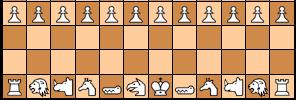
The game is played on a checkered board with 10 files and 8 ranks. The right corner on each player's side is light colored. The usual Chess setup is used except that it gets extended to 10 files by placing the Centaur between the Rook and Knight on the Queen-side, by placing the Champion between the Knight and Rook on the King-side, and by placing two more Pawns on each player's second rank. Chess pieces move as usual except that there is no castling, there is no en passant capture, and a Pawn's double move is forbidden when it would block a check but would also land next to an enemy Pawn in an adjacent file on the same rank. The Centaur may move as either a Bishop or a Knight, and the Champion may move as either a Rook or a Knight. A Pawn may promote to a Queen upon reaching the last rank on the other side of the board, but it is uncertain whether any underpromotion is allowed. The game is won by checkmate of the King, and it is drawn by the usual draw conditions of modern chess, which are stalemate, insufficient mating material on both sides, perpetual check, threefold repetition, or the 50-move rule.
White:
King f1; Queen e1; Champion i1; Centaur b1; Rook a1, j1; Knight c1, h1;
Bishop d1, g1; Pawn a2, b2, c2, d2, e2, f2, g2, h2, i2, j2.
Black:
King f8; Queen e8; Champion i8; Centaur b8; Rook a8, j8; Knight c8, h8;
Bishop d8, g8; Pawn a7, b7, c7, d7, e7, f7, g7, h7, i7, j7.
Modern Carrera's Chess
The same setup can be played using the the rules of Capablanca's Chess. This variant, created separately by both Fergus Duniho and Sam Trenholme, is played exactly like modern Chess except that the King moves three spaces toward the Rook when castling, and the Pawn's promotion options include the two new pieces.
Equipment
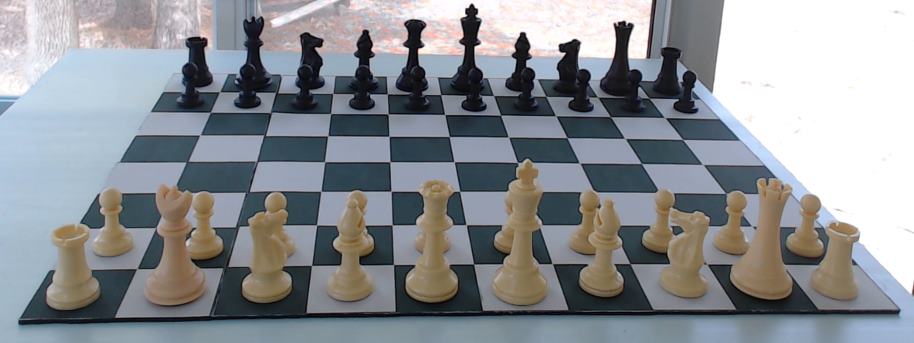
You can use some kind of Chess variant construction set that will let you make boards of different shapes and sizes. You might use a Rook and a Bishop from a larger Chess set to represent the Champion and Centaur, or you could buy specially made pieces. Omega Chess actually comes with a piece called the Champion, but the two pieces in this game are more commonly known as the Chancellor and Archbishop, and the House of Staunton sells these pieces.
WWW page created: July 10, 1997.