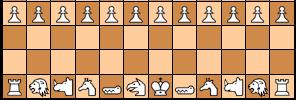
CSIPGS (comp.sys.ibm.pc.games.strategic) Chess
Ralph Betza invented in 1998 the chess variant csipgs chess. In this variant, players place pieces they designed themselves on the board, paying for the pieces with `zorkmids', for which they received one per turn. Here, you can see a handy overview made by Andy Kurnia, and some untried variants by me.More pages on csipgs chess
Overview
While playing a game of csipgs agains me, Andy Kurnia made a handy overview of the game. While it does not explain the game fully, it is a handy list to consult when playing the game. For full details, see Ralph Betza's page on csigs chess.
Board:
    Standard 8x8
Initial:
    Pieces: W(royal-WF)e1, B(royal-WF)e8
    Designs: B=3, BR=9, fcFfmW=2, N=3, R=5, royal-WF=12
    Zorkmids: 0
    Reserves: none
Turn:
    Credit:
        Add a zorkmid
    Action: one of
        Move a piece
        Transfer a reserve to board adjacent to a not-in-check royal piece
        Buy a designed piece when no royal piece is in check
            (have enough zorkmids; less than 16 pieces in reserve + on board)
            --> payments for pieces are rounded UP
    Design: one of
        Change a piece design
        Do nothing
Goal:
    Checkmate the last royal piece after capturing the others
Differences from chess:
    No EP (?), no promotion, no pawn double step, no castling
Designs (multiply the atom's base cost by modifiers; sum the modified atoms):
    ORTHOGONAL              DIAGONAL                KNIGHTWISE
    Atoms:                  Atoms:                  Atoms:
        W = D = H = 1.5         F = A = G = 1.5         N = 3
        R (WW) = 5              B (FF) = 3.3            L = 3.3
                                                        Nr (NN) = 5.5
    Modifiers:              Modifiers:              Modifiers:
        f = s = 0.5             f = 0.7                 f = 0.7
        b = 0.2                 b = 0.4                 b = 0.4
        m = c = 0.6             m = c = 0.6             m = c = 0.6
                                                        wide = narrow = 0.5
    Official whole-piece modifiers:
        Colorbound = 0.9
        Royal = 4
    Unofficial:
        Relay = 2
        Doublemove = 6
Variants
Here are a few variants, I thought up.Balanced csipgs chess
In csipgs chess, black has two disadvantages against white: he gets to move after white, and he is always a zorkmid down. There are a few ways to correct this.Balanced csipgs chess I
Black is given one zorkmid before the game starts. This balances the game slightly towarks black.Balanced csipgs chess II
The half-zorkmid is also a valid currency. So piece values are rounded up to either an integer or an integer plus 0.5. (For instance, when a player has 2 zorkmids and he buys a Wazir, he keeps half-a-zorkmid in his treasury.)Black starts the game with 0.5 zorkmid in its treasury.
Power csipgs chess
Each turn, players receive more than one zorkmid. In Weak power csipgs chess, players receive two zorkmids per turn. In Standard power csipgs chess, players receive four zorkmids per turn. In Strong power csipgs chess, players receive seven zorkmids per turn. In Super power csipgs chess, players receive ten zorkmids per turn.The stronger power csipgs chessses should be played with a different deployment rule: buying pieces is done in the design phase (i.e., instead of changing a design), not in the action phase. In particular this means a player can buy a piece and simultaneously deploy or move another piece.
Progressive csipgs chess
White receives one zorkmid on his first turn. Then, black receives two zorkmids. Then, white receives three zorkmids, etc. So, each turn, a player receives one zorkmid more than the other player at the previous turn. Apart from that, the game is not changed.Optional: have pieces bought in the design phase.
This game may well have a winning strategy for one of the two players.
Drawless csipgs chess
Play the standard csipgs chess game. After an agreed number of turns (e.g., 50), each player receives 2 zorkmids per turn. Each 10.5 (or another agreed upon number of) turns, each player again receives one extra zorkmid per turn. After the 80th (or another agreed upon number) turn, it is illegal to buy new royal pieces. After the 110th turn (or another agreed upon number), the doublemove modifier becomes legal.Agreeing to a draw is illegal.
As far as I can see, any sensible play should end this game in a win for a player after some time.
Configurable csipgs chess
Instead of designing a new piece, a player can make an invention. In such a case, he can propose either a new modifier or a new atom.Both players estimate the cost of a proposed atom, or the modifier multiplier. The highest estimate is used. After that, during the rest of the game the new atom or modifier can be used with this cost or multiplier.
For instance, a player can propose an `Chinese Knight' atom. This is a piece, moving like a Chinese Knight: the difference with a normal knight is that the chinese knight does not jump. (See the rules of Xiangqi.) The player estimates that this Chinese Knight atom costs 2 zorkmids, while its opponents gives it 2.4 zorkmids. After that, the Chinese Knight atom can be added to pieces for 2.4 zorkmids. The same modifiers (narrow, wide, forward only, backwards only, capture only, move only) as for knights apply for Chinese Knights. So, if a player buys a piece that can move and capture as a wazir and capture as a Chinese Knight, the cost of that piece would be 1.5 + 0.6 * 2.4 = 2.94.
As another example, a player could propose a runner-modifier. Applied to an atom, it means that the piece can continue to move in the specific direction, until it comes to an occupied square. So, a rook is a running-W, and a bishop is a running-F. The player proposes a multiplier of 5, while its opponent, proposes a multiplier of 4. Then, after this, the runner modifier can be used with multiplier costs of 5 (which is probably too much.) A piece that moves and captures as a running dabbaba and as a bishop would cost (5 * 1.5 + 3.3) * 0.9 = 9.72, i.e., 10 zorkmids. (Note that the 0.9 modifier is applied as this piece is color-bound.)
Dutch csipgs chess
Piece values are rounded up to 0.1's of zorkmids. So, if a player buys a piece whose exact value is 2.32 zorkmids, and there are 4 zorkmids in his treasury, he pays 2.4 zorkmids and keeps 1.6 zorkmids in his treasury.Army csipgs chess
At the start of the game, each player receives 52 zorkmids. (Or another value the players agree upon.) With this, he buys 16 pieces, which he must deploy on the first two rows at his side of the board, following the following rules:- The total unrounded value of the pieces is calculated. This should be less than 52 zorkmids. If a player does not spend all of his zorkmids, he loses the rest. (Alternatively: he keeps them, or he keeps half of them, rounded down.)
- The player must buy at least one royal piece, or he loses the game immediately. (If both players forget to buy a royal piece, black wins.)
- Each piece, placed at the second row of the board should have a value of at most two zorkmids. (Alternatively: use instead: pieces at the second row of the board may only move and capture forwards.)
- Buying and deployment is done concurrently and in secret: both players write down what pieces they buy, and how they are placed. (Alternatively: players buy and place alternatingly a piece.)
- The player must buy 16 pieces.
After the setup is revealed, white starts the game, which is played further as standard csipgs chess.
A player can buy a normal chess army, although the pawns do not promote in this game.
Written by Hans Bodlaender; shorthand overview of csipgs chess by Andy Kurnia.
WWW page created: April 22, 1998. Last modified: May 19, 1998.