Combining Knightmare Chess
Peter Aronson
Introduction
In Combining Knightmare Chess the capture of a piece other than a Pawn or a King by a piece other than a Pawn or King results in a Knightmare piece that belongs to both sides, and can be moved by either.General Rules
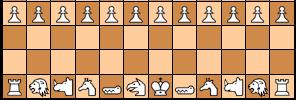
The rules of Combining Knightmare Chess are identical to those of FIDE Chess, except where noted otherwise below. The standard setup is used.There are three general categories of pieces in Combining Knightmare Chess:
- Pawns and Kings;
- Uncombined Knights, Bishops, Rooks and Queens, referred to as "regular" pieces;
- Knightmare pieces.
Pawns and Kings capture and are captured (or in the case of Kings, threatened with capture) as in FIDE Chess.
Regular pieces move as they normally do, but when one makes a "capturing" move to a square containing an opposing regular piece, instead of a capture occuring, the two pieces become a Knightmare piece that thereafter must be moved as if one piece.
A Knightmare piece consists of two pieces, one from each side. It may be moved by either player as the piece of their color making the Knightmare up. So a Knightmare piece consisting of a White Knight and a Black Rook would be moved by White as a Knight, and by Black as a Rook.
A Knightmare piece may capture normal or Knightmare pieces. Normal pieces may capture Knightmare pieces. Pawns and Kings may capture (and be captured by) any other piece.
A piece may not move twice in a row without another piece being moved in between. So, if the White player just formed a Knightmare piece by moving a Knight into a square containing a Black Bishop, the Black player may not move the resulting Knightmare piece on the turn immeadiately following as that would result in White's Knight moving twice in a row without any intervening move. And as long as White moves that Knightmare piece every turn, Black may not move it. Only once White moves a different piece may Black move then the Knightmare piece, and then White may not move it until after a turn in which Black does not move it.
A Knightmare piece still offers check, even when it is not allowed to move because it was just moved and another piece has not been moved yet -- this is a form of pictorial check. This means that forming a Knightmare with a piece does not lift check by that piece. This allows fool's mates by Knight to c7 or g7 (c2 or g2 for Black) if an escape route hasn't been opened for the King.
Notes and Comments
Combining Knightmare Chess was inspired by V.R. Parton's incomplete game of Knightmare Chess and David Howe's game of Bifold Halfgi, and a series of as yet unpublished Bifold Chess variants that David and I played by e-mail a few years ago.This game changed a fair bit in the course of playtesting. In the original version, any two pieces formed a Knightmare pieces, including Pawns and Kings. This simultaneously made defense difficult and draws common, and several games ended with both side's Kings incorporated into Knightmares along with a Queen or a Rook. So I bethought myself of Ralph Betza's Zero Relay Chess, and realized that if I made the Pawns and Kings work as in FIDE Chess, things settled down quite a bit.
This helped, but it was very easy for a game to devolve into a single dangerous Knightmare piece bouncing around the board, being moved alternatively by both players. So that's why the rule forbidding a piece to be moved twice without another piece being moved in between was added. It also gave an advantage to the "capturing" player -- as long as they kept moving the newly formed Knightmare piece, they kept control of it. Otherwise, it could sometimes be a distinct disadvantage to form a Knightmare piece. However, Combining Knightmare Chess is still more drawish than Orthodox Chess.
Thanks to Ben Good, John Lawson and Tony Quintanilla for playtesting and comments.
Equipment
Most likely the easist way to play Combining Knightmare Chess is with the board from a large Chess set, and the pieces from a small set. Stackable pieces would work as well, as long as players were allowed to inspect the stacks.Notation
Standard Chess notation does fine for most moves. Knightmare pieces are indicated by two letters, where the letters are in order of rank, rank order being Q - R - B - N. Thus, a Queen-Knight Knightmare piece is always QN, regardless of who owns which part. Example: QNe4.The other thing that can be notated differently is the combination of two pieces into a Knightmare piece. This could actually be represented as a capture, as the there is no ambiguity in when a piece is actually captured, and when it becomes part of a Knightmare piece instead. However, in practice, notating these moves differently than captures seemed to make the moves easier to read in play by e-mail. Ben Good and I, at Ben's suggestion, used the form moving-piece tilde stationary-piece square. Example: Q~Nc2. The tilde may be a different character in different national character sets, but any character not used in standard Chess notation will do.
Computer Play
I've written an implementation of Combining Knightmare Chess for Zillions of Games. You can download it here:
Written by Peter Aronson.
WWW page created: May 12th, 2003.