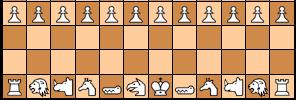
Cannibal Chess and Absorption Chess
Michiel de Bondt from Nijmegen, the Netherlands informed me about a variant called Cannibal Chess. In the Encyclopedia of Chess Variants, a related game, also known under the name of Cannibal Chess, but also under the name of Absorption chess is mentioned.Rules of both variants are given here.
Rules of Cannibal Chess
The normal rules of chess are valid, with the following change:When a piece takes another piece, its gets the movement abilities of the piece it has taken. For instance, if a white rook takes a black knight, the white rook turns into a white knight. (The best is to use a second set and indeed change the piece to the actual piece.)
When a king takes a piece, it also turns into that kind of piece, but it stays royal. I.e., if a king takes a pawn, it can only move as a pawn, but it stays the piece that must be mated. If that king/pawn reaches the last row of the board, the king/pawn can be promoted to a king/queen, so now the opponent must mate a piece with the abilities of a queen - until, of course, that queen also takes a piece, etc.
Castling is only allowed with the original rooks, under normal castling rules.
Rules of Absorption Chess
Absorption chess uses the rules of orthodox chess, with the following addition.Whenever a piece takes another piece, it gets the movement capabilities of that piece in addition to those it already had. So, if a rook takes a bishop, that piece can effectively move like a queen. A piece can accumulate the capabilities of several pieces. There are a few special rules:
- Kings may not move over attacked squares. However, kings do give check over attacked squares.
- A piece whose capabilities include that of a pawn can only promote when it makes a move as a pawn to the last row.
Pritchard recommends playing this game in progressive fashion, e.g., by postal play.
Play It!
Use Zillions of Games to play this game! If you have Zillions of Games installed, you can download this game and play it.Based on an email of Michiel de Bondt and the Encyclopedia of Chess Variants. Written by Hans Bodlaender.
WWW page created: February 9, 1999.