Placement
Several chess variants have a different opening setup, or have pieces that can be dropped. Placement, sent to the Chess Variant Pages in October 2000, is like these, with its own specific set of rules.Rules
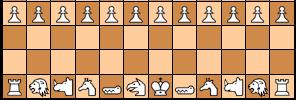
The game is played by 2 players on an 8 by 8 board. Both players start with only the kings on their original squares (white king on e1, black king on e8.) The other 15 pieces of a player are in reserve.


Players may make usual rules, or may take a piece from its reserve, put on its original square and move from it in one move. The original square must be empty.
For instance, white could move in one turn move a knight from its reserve to b1 (if b1 is empty) and then from b1 to c3. Note for instance also that when a black rook occupies square a1, then, while white has a rook in reserve, the rook cannot be dropped on a1 while the square is occupied, but as soon as black moves its rook from a1, then it can be taken by a rook that first is dropped on a1.
WWW page made by Hans Bodlaender, based on emails from Walter Weiss.
WWW page created: October 19, 2000.