Baseline chess
The idea to undo opening theory and start chess with different opening setups is at least one and a half century old. Already in the middle of the 19th century, people have played a variant, where the rules of chess are followed, except that the opening setup is different.
In this way, knowledge of opening theory loses its importance - some will consider this an advantage as players cannot rely on memory for the first turns, while others may consider this as a disadvantage and may point out that many random opening setups do not have characteristics like a good balance of the pieces, all pawns that are guarded in the setup.
The Encyclopedia of Chess Variants, by David Pritchard, lists several versions of Baseline Chess, and several names under which such games are known, e.g., Randomized Chess, Array Chess. A well known recent form is Fischer Random Chess, a variant proposed by formed world chess champion Bobby Fischer. A variant that was enthusiastically played by many people is Transcendental Chess.
Rules
Basically, Baseline Chess is Chess, played from a randomized setup. In the setup, all pawns are still on their original places, i.e., on the second and seventh rows of the board. However, the pieces on first and eight row are placed on possibly different positions on those rows. (The pieces of white are still on the first row, the pieces of black on the eight row.)Apart from this setup and possibly castling rules, the rules of chess are followed. However, a few points are not addressed by the description above, and these give way to a number of different variants of Baseline Chess.
What setups are allowed?
Three different options are known about what setups are allowed for one row of pieces:- Any of the permutations of the pieces is allowed.
- It is required that Bishops are on squares of different colors.
- Fischers' setup: bishops must be on different colored squares, and the king must between the two rooks.
Castling rules
If king and rook are not on their original setup, then the original castling rules are not applicable anymore. Amongst even more options, the following different possibilities are available:- Castling is abolished. This has as consequence that even when the game starts in the normal setup, the rules are different from usual chess.
- Castling is only possible if the king and rook are on the same positions as in orthodox chess.
- Castling is only possible by a rook on the a- or h-line, and a king on the d- or e-line. The king always moves two squares towards the rook, the rook to the square at the other side of the king.
- Castling as in Fischer Random Chess.
How is the opening setup determined?
Several different ways of selecting the opening setup are possible.Setup determined randomly
With the help of a die, a computer program, or just by drawing pieces randomly from the box, the setup is determined.This systems guarantees the greatest variety in setups. When white and black have different setups, the game may be unfair, so one should either play two games with the same setup, use a bidding system (see Trancendental Chess, or let the weakest player choose which side to play after the setup has been made.
Depending on how many setups are allowed, there is a smaller or larger probability that the game is equal or almost equal to orthodox chess.
Setup selected by third party
In a tournament, the organizers could select a setup, either randomly or they can choose a setup that they find suitable themselves. The players then play with this setup.Setup agreed upon by the players
The players could agree on a different setup. This is most suitable for casual play - in serious matches, players may have prepared opening theory for a few setups and propose those.One could also let the players place one piece at the time, turnwise, mirroring the pieces of black and white. E.g., white places a rook on b1, then this rook is mirrored with a black rook on b8. Then, black chooses to put the king on h8, and hence whites king goes to h1, etc.
Setup determined by players individually
One could start the game by letting the players decide themselves which setup they play. Again, two options are possible: one can have players put a piece on their baseline one by one: white places a piece, then black places a piece, etc., or one can let players make an opening setup in secret.This version adds a new element to the game: the skill of making a good setup. Already after the setup phase, before a `real' move has been played, one of the players may have a possibly decisive advantage (for players of approximately even strength). An example of a game with this rule is Real Chess.
Comments
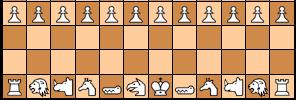
As one can see, there are many different forms of Baseline (or Randomized) chess. The idea to change the opening setup is already quite old, and the usual purpose of such proposals is to undo opening theory, which puts too much emphasis to preparation of games. However, several variants of Randomized chess allow their own opening theory. For instance, Fischer Random Chess has 960 different setups: while these are quite a lot, it is not too much to develop for each some opening theory (note also that each position has its mirror, meaning that there are 480 setups to study), thus this could make the problem of having to know opening theory even larger.When setting up the position, some players may have a preference for using the position for which they know their opening theory. Others may prefer a carefully chosen different setup, e.g., with rooks on the central lines. Consider the following position. What is your opinion about what player has a better position?


Comment on position
Ken Regan comments on the position above:I think White is almost lost (especially if he can't castle:-). I mean, looking at the diagram, I feel in my gut the power of those Black Rooks and Bishops. That's why Fischer's "King between the rooks" is an inspired addition...
Switching positions
A similar, but slightly different idea has been proposed by one of our readers (`PHO' - no full name was given in the email.) The following rules are in effect:- A player, who has not moved a pawn forward or a knight from the
first rank has the option of switching the position of two pieces along the
back rank, in lieu of his turn to move. The player can elect to do this
on each of his turns as long as he has not yet moved a pawn forward or a
Knight from the first rank, and none of the following conditions and
restrictions are violated:
- A Bishop can only switch with a piece that resides on the same color square as itself.
- A particular piece can be involved in only one switch during the game.
- Like pieces cannot be switched with each other, (Rook for Rook..., which is ridiculous anyway.
See also
Written by Hans Bodlaender and `PHO'.
WWW page created: 11 Sept 2000. Last modified on: December 1, 2000.