Chess Variant Construction Set

Take a quick survey of the many Chess variants described on this site, and you will soon realize that only a fraction can be played with the usual Chess equipment. Many others include extra pieces or are played on non-standard boards. While you can buy sets for some of these games, there are still many more you cannot buy sets for. Besides that, even if commercial sets were available for every variant, it could get ridiculously expensive to buy a separate set for each game you wanted to play. A much more practical solution is to put together a Chess variant construction set, which you can use to put together boards and supply pieces for a wide variety of games. You cannot buy one readymade, but you can put one together.
I came up with the idea of a Chess variant construction set in 1998, shortly before I got involved with this site. After I met David Howe, he improved on my idea, putting together a better set than I had made. The idea is similar to having something like Legos, Lincoln Logs, Tinker Toys, or Micronauts, which you can put together into different combinations to make different toys out of. The main ingredients of a Chess variant construction set are Chess pieces and board parts. A good set should include various fairy pieces and a few sets of standard pieces. Board parts will generally consist of single spaces and board segments that can be quickly pieced together into various board shapes. I have provided affiliate links for buying suitable products, and I try to keep these up-to-date.
Pieces
There are various sources for pieces. These include:
- Chess variant sets
- Chess variant piece kits
- Chess sets in different styles
- RPG Figurines, such as those for Dungeons & Dragons
- Game pieces from non-Chess games
- Toys
- Handmade pieces
- 3D printed pieces
Chess variant sets
The sets I own with some non-standard pieces include Cambaluc Chinese Chess, Gothic Chess, and Omega Chess. Unfortunately, manufacturing Chess variant sets has never had much financial success, and none of these sets are commercially available at this time.
Chess variant piece kits
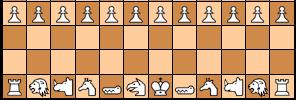
There are currently many Musketeer Chess Variant kits available. These normally come in sets of four, in which there are two different pieces of each color. The pieces are comparable in size to tournament size Chess pieces and work well with plastic tournament sets. The link goes to a page featuring photos of these pieces and affiliate links for purchasing them. The photo at the top shows Xiangqi, the Chinese form of Chess, set up with pieces from a few of these kits, along with some regular Chess pieces. The logo on the homepage also shows some of these pieces, though with some recoloring.
Chess sets in different styles
While Staunton pieces are the most popular, Chess sets come in a wide variety of styles. Some are simply alternate styles for playing Chess, such as E. S. Lowe's Renaissance pieces, which are figurine representations of people, or Peter Ganine's Classic pieces, which were frequently seen on Star Trek, his Superba or Gothic pieces, which have faces and were sometimes also seen on Star Trek, and his Conqueror pieces, which are figurine like the Renaissance pieces. There are also many themed sets, sometimes based on history, region, myth, legend, or fiction.
You may also get Chess sets in different sizes or colors or made from different materials. For example, in my Cavalier Chess photos, I used Knights from small, cheap plastic sets for the Cavaliers.
RPG Figurines
Role playing games like Dungeons & Dragons make use of figurines of various types of heroes or monsters. You can usually buy these individually and paint them as you like.
Game Pieces
Some games may come with pieces that can be used in Chess variants. Checkers may be placed underneath Chess pieces to indicate that their piece type is different.
Toys
You may be able to find some toys that are suitable as variant pieces. I have sometimes used small toy elephants, for example.
Handmade Pieces
Our Craft pages describe some projects for making your own Chess variant pieces. Some things I've tried include using wooden shapes you can get at a craft store and attaching moldable plastic to Chess pieces to modify them.
3D Printed Pieces
3D printers are now available, and some people use them to produce Chess variant pieces. Since I do not own one myself, I have not done this.
Boards
I originally cut squares out of cardstock, which I would meticulously piece together, then place clear plastic sheets over to keep them in place. David Howe improved on this idea by buying chess boards made of rubber and cloth like mouse pads are, then cutting them up into different shapes that could quickly be put together into different board shapes. I won't recommend cutting squares out of cardstock. Cutting up mousepad-style chess boards is the much better option. Because you can cut them into different shapes, making a board is much quicker than laying out squares one at a time. Because the pieces are heavier than cardstock, you don't have to cover them with anything. And since you're cutting up chess boards, the end result looks more like regular chess boards than cardstock would. Depending upon your needs, I recommend getting from two to four beige and olive chessboards and an additional one with dark squares that are a different color than olive. I got one with beige and dark blue squares. This is used for games in which some squares should be in a third color.
Wholesale Chess has
- mousepad style boards with 2.25 inch squares in three different colors
- larger mousepad style boards with 2.375 inch squares in the three same colors
The House of Staunton has
- soft mousepad boards with 2.25 inch squares
- thin mousepad boards with 2.25 inch squares
- large soft mousepad boards with 2.375 inch squares
I recommend the boards with smaller squares, and I have four reasons for this.
- 2.25 inches is a perfectly adequate size for tournament size Chess pieces and the Musketeer Chess variant pieces. In the Chinese Chess photo at the top, the board is made with 2.25 inch squares, and pieces on the board are tournament size Chess pieces with some Musketeer Chess pieces.
- With the smaller size, your boards will take up less space, which will allow you to fit more ranks and files into a smaller area.
- Because they use less material, the boards with smaller squares are cheaper.
- The House of Staunton carries many additional novelty and decorative mousepad Chess boards in the 2.25 inch square size, and you might want to include some of these in your construction set.
Regarding the novelty and decorative boards, these are all in the thin style, not the soft style. So, if you want to use them, you should probably get your main boards in the thin style. The plainer boards will be more useful than the more decorative ones. I would particularly recommend the Red/White, the Red/Gray, and the Green Wood boards. One caveat I'll add is that I believe I bought soft boards, and so I don't have any experience with what the thin boards will be like.
The following instructions assume you got mousepad boards in one main color and one supplementary color, here depicted as green/beige and blue/beige.
First Board
|
Second Board
|
Third Board
|
Fourth Board
|
First Two Boards
With segments cut from the first two boards, you can make the following boards:
8x8 for Chess
The standard 8x8 board can be most quickly constructed from the four 4x4 segements. |
9x9 for Shogi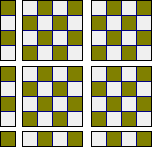
A 9x9 board can be made by adding four 1x4 strips on two sides of an 8x8 board, with a single space added in the corner. |
10x8 for Capablanca Chess and many other games
A 10x8 board can be made by combining four 4x4 segments with two 2x4 segments. |
10x10 for Grand Chess
A 10x10 board can be made from the four 4x4 segments, four 2x4 segments, and one 2x2 segment. |
11x11
An 11x11 board can be made by adding four 1x4 strips and two 1x2 strips to two sides of a 10x10 board, with a single space added to the corner. |
Omega Chess
An Omega Chess board can be made from adding a single space to each corner of a 10x10 board. |
First Three Boards
With segments from the first three boards, you can make the following additional board:
12x12 for Gross Chess
A 12x12 board can be made by placing all ten 1x4 segments and two 1x2 segements around a 10x10 board. Place three 1x4 segments on the left and right sides, and two 1x4 segments plus a 1x2 segment on the near and far sides. |
All Four Olive/Beige Boards
With segments from all four boards, you can make the following additional boards:
12x12 for Gross Chess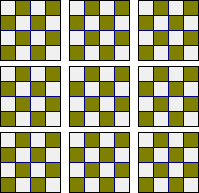
A 12x12 board can more quickly be made out of all nine 4x4 segments. |
13x13
A 13x13 board can be made by placing 1x4 segments along two sides of a 12x12 board with one single square in the corner. |
14x14
A 14x14 board can be made by placing three 2x4 segments on one side, then the remaining 2x4 and the two 4x2 segments on the other side with some 1x2 segments for spacing, since 2x4 and 4x2 segments don't align. |
15x15
A 15x15 board can be made by placing the additional segments from 13x13 and 14x14 around a 12x12 board and adding a couple more 1x2 segments to fill things in. |
16x16
A 16x16 board can be made by putting all four boards back together. |
4x4x4x4 for 4D Chess
A 4D board can be made out of 16 separate 4x4 areas. In this diagram, the 4x4 areas alternate between two checker patterns, so that every orthogonally adjacent neighbor of a space is a different color. |
Making More Colorful Boards
Because a variety of games can make good use of boards with three colors, I recommend getting an additional mousepad-style board with a different color for the dark squares. I recommend cutting it up like so:

- Ten 1x4 strips
- Five 1x2 strips
- One 2x2 block
- Ten single spaces
The main use for this extra material is to mix with the main green and buff material to make three-color boards or to distinguish some areas of your board. Here are some samples of what you can do.
Cavalier Chess
A Cavalier Chess board can be made by interlacing 1x4 strips of alternating colors. |
Grand Cavalier Chess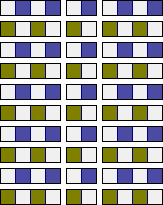
A Grand Cavalier Chess board can be made by interlacing 1x4 strips and 1x2 strips of alternate colors. Each of its ten rows would have two 1x4 strips and one 1x2 strip. You would alternate color on a row by row basis. |
Jumping Chess
A Jumping Chess board can be made by adding a different color trim around an 8x8 board. |
Philosopher's Chess
The mind board in Philosopher's Chess can be represented by the alternately colored 2x2 block. |
Fusion Diamond 41
Although this pattern for a 41 square diamond shaped board does not use three colors, it does use all nine light colored single spaces, five of which come from the alternate colored board. |
Vyrémorn Chess
This pattern uses all four 4x4 segments, two 2x4 segments, five 1x4 segments, and one 1x2 segment from the green/buff material and seven 1x4 strips and one 1x2 strip from the extra material. |
Chinese Chess
This follows the example of Cambaluc Chinese Chess of using the same checker pattern for each side, but instead of outlining the palaces, it distinguishes them by a different color for the dark spaces, which it uses for the diagonals. Since the diagonal is dark, the whole checker pattern is the reverse of what it is for Cambaluc Chinese Chess. |
Written by Fergus Duniho
WWW Page Created: 10 November 2001; Last Updated 11 November 2001.