Shifting Sands Chess
(or A Pawn By Any Other Name...)
Introduction
I developed Shifting Sands Chess as an extension of my Chameleon. It is one of many variants in which the pieces change type depending on their location--sometimes their file, sometimes their square, etc. In Chameleon, pieces change type depending on the color of the square they landed on. The board has a pre-established color pattern. The difference is that in Shifting Sands Chess the color square pattern is not pre-determined. The players drop colors during the game. In fact, not only may the players drop colors, but may shift them too.
Shifting Sands Chess is submitted as a non-competing game in the 42-Squares Contest!
Although not described here in more detail, Shifting Sands Chess can also be played on a 64-square or 100-square board.
Setup

Pieces
 King | The King moves one space in any direction, but may not move into check. In
Shifting Sands Chess, the King does not get to castle. The King is not
affected in any way by color squares.
When a King enters a color square, the color is removed--regardless of the owner of the square. The player that checkmates the opponent's King wins the game. |
 Knight | The Knight moves as the Knight in Chess, jumping in an L shape, two spaces forward and
one to the side.
Normally, a Knight is introduced into the game when a Pawn or another piece moves onto a Light Blue square. A Knight on a non-color square is rare. It would only occur as a result of the promotion of a Pawn from a non-color square to a Knight on a non-color square, or when a Knight on a Light Blue square moves onto a non-color square on the 8th rank. A Knight will change type depending on the color of the square it lands on: if Yellow, a Queen; if Purple, a Rook; if Red, a Bishop; if Light Blue, it remains a Knight; if Dark Green, a Pawn; or if a non-color square, also a Pawn, except on the 8th rank, where it remains a Knight. |
 Rook | The Rook moves as the Rook in Chess, any number of spaces orthogonally. There is no castling.
Normally, a Rook is introduced into the game when a Pawn or another piece moves onto a Purple square. A Rook on a non-color square is rare. It would only occur as a result of the promotion of a Pawn from a non-color square to a Rook on a non-color square, or when a Rook on a Purple square moves onto a non-color square on the 8th rank. A Rook will change type depending on the color of the square it lands on: if Yellow, a Queen; if Purple, it remains a Rook; if Red, a Bishop; if Light Blue, a Knight; if Dark Green, a Pawn; or if a non-color square, also a Pawn, except on the 8th rank, where it remains a Rook. |
 Bishop | The Bishop moves as the Bishop in Chess, any number of spaces diagonally.
Normally, a Bishop is introduced into the game when a Pawn or another piece moves onto a Red square. A Bishop on a non-color square is rare; it would only occur as a result of the promotion of a Pawn from a non-color square to a Bishop on a non-color square, or when a Bishop on a Red square moves onto a non-color square on the 8th rank. A Bishop will change type depending on the color of the square it lands on: if Yellow, a Queen; if Purple, a Rook; if Red, it remains a Bishop; if Light Blue, a Knight; if Dark Green, a Pawn; or if a non-color square, also a Pawn, except on the 8th rank, where it remains a Bishop. |
 Queen | The Queen moves as the Queen in Chess, any number of spaces in any single direction.
Normally, a Queen is introduced into the game when a Pawn or another piece moves onto a Yellow square. A Queen on a non-color square is rare; it would only occur as a result of the promotion of a Pawn from a non-color square to a Queen on a non-color square, or when a Queen on a Yellow square moves onto a non-color square on the 8th rank. A Queen on will change type depending on the color of the square it lands on: if Yellow, it remains a Queen; if Purple, a Rook; if Red, a Bishop; if Light Blue, a Knight; if Dark Green, a Pawn; or if a non-color square, also a Pawn, except on the 8th rank, where it remains a Queen. |
 Pawn | The Pawn moves as the Pawn in Chess, except that
it may not capture by en passant. On its initial move it may move two squares.
Upon reaching the last rank, a Pawn moving from a non-color square may promote to a Queen, Rook, Bishop, Knight, or remain a Pawn. A Pawn moving from a Dark Green square must promote to a Queen. A Pawn will change type depending on the color of the square it lands on: if Yellow, it changes to a Queen; if Purple, a Rook; if Red, a Bishop; if Light Blue, a Knight; if Dark Green, it remains a Pawn; or if a non-color square, it remains a Pawn, except on the 8th rank, where it may promote. |
Rules
Shifting Sands Chess is played like FIDE Chess with the following exceptions:
- The main variant of this game is played on a 42-square board, 6 files x 7 ranks.
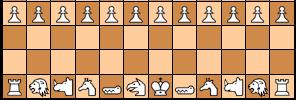
- The initial array consists of all Pawns on the first two ranks, except for the Kings on the C1 and C7 squares.
- The first four moves of both players must be to drop a color square. Color squares must be dropped on an non-color square. During the game, a total of 2 squares each of the following colors may be dropped: Yellow, Purple, Red, Light Blue, Dark Green, and Blue.
- Color squares originally dropped by the moving player may be moved one square in any direction, similar to a King, but only into an empty non-color square. Blue squares may not be moved.
- When any piece or Pawn, except a King, enters a color square dropped by either player, it changes type. If the square is Yellow, it changes into a Queen; if Purple, a Rook; if Red, a Bishop; if Light Blue, a Knight; if Dark Green, a Pawn. A Blue square may not be entered at all, except by a King--which removes the Blue square.
- Kings are not affected in any way by colors. When a King enters a color square, the color is removed.
- When any piece, except a King, enters a non-color square, it changes to a Pawn. The only exception is when the non-color square is on the 8th rank. In that case it remains the same type of piece, instead of changing into a Pawn.
- There is no castling.
- On the 8th rank, Pawns may promote to Queen, Rook, Bishop, Knight, or remain a Pawn, if they are coming from a non-color square. If they are coming from a Dark Green square, they always promote to a Queen.
- Pawns on either the first or second rank may make a double move as their initial move, but may not capture by en passant.
Playing Tips
Force: As in FIDE Chess, material advantage and concentration is the key to achieving your goals and ultimately to checkmating the King. In Shifting Sands, however, piece types are mutable, so numerical superiority plays a larger role. In Shifting Sands, force is more difficult to concentrate because pieces mutate depending on the color of the square they land on. An important element of strategy, therefore, is to drop colors strategically.
Time: As in FIDE Chess, time is critical for concentrating one's material, as well as to do so in an advantageous manner. In a way, in Shifting Sands, time is more critical because concentration of force is more difficult. Adjusting the location of colors is time consuming. Again, strategic planning in the dropping of colors will help considerably in the effective use of time.
Space: As in FIDE Chess, space both gives freedom or movement or limits it. Players should develop strategic goals that will enhance their own use of space and limit their opponent's. Again, the dropping of colors should be done strategically to further these goals. Shifting of color squares is an option, but is slow. The Blue squares, which may not be entered can be used in critical situations to advantage. The King, which ignores and eliminates colors, can also "reorganize" space around itself by limiting the options of pieces seeking to move near it. Elimination of colors, however, is a two-edged sword!
Pawn Structure: In FIDE Chess, Pawn structure is very important because of the mutual support of Pawns, their promoteability, and their relatively low worth in the game--individually. In Shifting Sands, Pawns are highly mutable and are worth more. Nevertheless strategic positioning of Pawns with respect to the developing color pattern of the board is critical to achieving one's goals.
Computer Play
If you have Zillions of Games, you may play Shifting Sands Chess against your computer or by e-mail using saved Zillions files. The Zillions of Games version also includes a 64-square version and a 100-square version of the game. You may download a zip file that includes the rules file and all the needed image files.
Equipment
A 6x7 Chess board and all the regular Chess pieces are used.
Color squares can be made from color paper and placed over the squares on the board.
A 6x7 board can be made by cutting a cardboard board or by delimiting a 6x7 area on a regular 8x8 board.
Written by Tony Quintanilla
WWW Page Created: December 28, 2001.