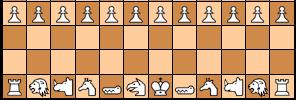
The One Ring

After introducing a friend to my Fellowship of the Ring chess variant, and being fairly pleased with its playability, I decided to adapt it to a smaller board for entry into the 42-squares contest. The rules are identical to those of that game (except that White pieces with the Ring may step sideways). However, no familiarity with the full-size game is assumed in the description that follows.
The Rules

| Black: King c9 Rook a8, e8 Bishop c8, d8 Knight a7, e7 Queen b8 Pawn a6, b7, c7, d7, e6 White: King c0 Rook a1, e1 Bishop c1, d1 Knight a2, e2 Queen b1 Pawn a3, b2, c2, d2, e3 |
The promotion zone comprises the five forwardmost squares. White Pawns promote upon reaching a8, b8, c9, d8, or e8. Black Pawns promote on a1, b1, c0, d1, or e1.
Rules of FIDE Chess apply, with the following exceptions:
- There is an object called the One Ring that can be worn by any piece. Initially, it is not on the board. When the first White piece is captured, White chooses one of his pawns to wear the Ring. (After this is done, it is still White's turn to move.)
- A White piece wearing the Ring may step one space directly or diagonally forward, or sideways. A Black piece wearing the Ring may move as a Queen.
- When a piece wearing the Ring is captured, its captor puts on the Ring. If the captured piece was a White piece other than a Pawn, it trades places with its captor and becomes Black (corrupted by the ancient evil power in the Ring).
- A White piece with the Ring in White's promotion zone (a8, b8, c9, d8 or e8) may, as its move, destroy the Ring. When this is done, White wins the game.
- Only Pawns on the second rank may double-step. If they do so, they may be taken en passant by an enemy Pawn.
- Stalemate is a loss for the stalemated player.
Why I like this game
I must admit that I do prefer the 64-square version. However, I feel that The One Ring preserves the spirit in which the first game was created. Black is still motivated to acquire the ring, and White to defend it, at any cost.It seemed to get more difficult to create a balanced game on a smaller board. The asymmetry inherent in the Ring appeared to throw the dynamics more out of whack without the extra squares. I had Zillions play seventy games with itself (3-5 seconds, p3/450-Athlon/1200). White won 25, Black won 41 and there were 4 draws. However, when Zillions plays White, it always puts itself at a disadvantage by trading a Knight for a Pawn in order to bring the Ring into the game. This could have contributed to some of those Black wins.
What I dislike about this game
I'm not thrilled with the initial setup. It's not quite symmetrical and the Pawns aren't all lined up side by side. They're not even all defended (until you move the Knights out of the way). The opening game has a very cramped feel. There just aren't that many options.Sample Games
Play on Zillions!
History
My first attempt at adapting my game to a 42-square board was a seven by six rectangle. I removed double-step ability from the Pawns, but it was still too darn easy for White to traverse the short distance to the far rank. I got it into my head that eight was the ideal number of ranks. So, I made the board narrower. At first I tried to pack the army onto the zeroth and first ranks, using the second for Pawns and leaving out the Bishops. But I really didn't want to leave anyone out! And starting the Pawns one rank forward while stripping their double-step ability wouldn't change the number of steps the Ringbearer would have to traverse. Plus it makes room for those Bishops. This opening formation is seen in Game #1 above. Ultimately I decided that having Pawns on the second rank made more sense for Ring defense purposes. I considered adding a facing Kings rule (as in Chinese Chess) because some endgames were a little drawish, but that seemed to give Black an advantage for some reason.The One Ring inspired by J.R.R. Tolkien,
Invented by Robert Price.
Written by Robert Price.
WWW page created: March 8th, 2002.