Philosopher's Chess Example Game
This is a game played by me (Black) against my computer opponent (White). It's really just meant to illustrate the basics of the game, so please don't expect any amazing play quality!The notation is as I described on the main description page.
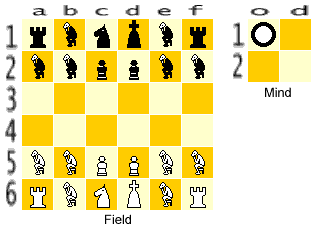
Anyway, starting with the initial board:-
| Graphical Diagram |
 |
| ASCII Diagram |
    a   b   c   d   e   f        o   d
  +---+---+---+---+---+---+    +---+---+
1 : r : h : n : k : h : r :  1 : t :   :
  +---+---+---+---+---+---+    +---+---+
2 : h : h : p : p : h : h :  2 :   :   :
  +---+---+---+---+---+---+    +---+---+
3 :   :   :   :   :   :   :      Mind
  +---+---+---+---+---+---+
4 :   :   :   :   :   :   :
  +---+---+---+---+---+---+
5 : H : H : P : P : H : H :
  +---+---+---+---+---+---+
6 : R : H : N : K : H : R :
  +---+---+---+---+---+---+
Field |
1. c5-c4 (White) -- computer starts
2. c2-c3 (Black)
3. d5-d4 (White)
4. c3-d4 (Black)
5. c6-d4 (White) -- and out comes the knight
6. mo1-o2 (Black) -- I move the thought
7. f5-f3 (White) -- computer's after my rook
8. mo2-o1 (Black) -- note that d2 would have put me in check
9. f3-f4 (White)
10. c1-d3 (Black)
11. c4-d3 (White) -- my move was silly after all
12. a2-a3 (Black)
13. d3-e2 (White)
14. f2-e2 (Black)
15. mo1-d1 (White) -- computer moves the thought
If you're following this, can you see why the computer did that?
Here's what I think: the philosopher at f4 was placed under attack by my rook by my last move. Switching philosopher moves from ortho-1 to diag-1 means that f4 is suddenly protected by the philosopher at e5. Since my computer player rates a rook higher than a diag-1 philosopher, it reasons that I won't sacrifice the rook in this situation. Of course, it was also defending the square with its own rook already.
16. b2-c3 (Black) -- but I will attack the knight
17. md1-o1 (White) -- a side-note here:-
The no-repetition rule would have forbidden me from reversing move 15 on my last move, if I'd wanted to, as it would have caused an earlier board position to recur. Since I moved a philosopher though, the board position changes and the computer is able to reverse its earlier mind-move without causing a repetition.
18. c3-c4 (Black) -- produce a dilemma
19. d4-f3 (White) -- the knight is protected by the philosopher
20. mo1-d1 (Black) -- no longer
21. b5-c4 (White) -- the computer takes my philosopher with its
philosopher and gets an enlightened philosopher
To clarify the board position at this point, here's what it looks like:-
    a   b   c   d   e   f        o   d
  +---+---+---+---+---+---+    +---+---+
1 : r : h :   : k : h : r :  1 :   : t :
  +---+---+---+---+---+---+    +---+---+
2 :   :   : p : p : h :   :  2 :   :   :
  +---+---+---+---+---+---+    +---+---+
3 : h :   :   :   :   : N :      Mind
  +---+---+---+---+---+---+
4 :   :   : E :   :   : H :
  +---+---+---+---+---+---+
5 : H :   :   :   : H :   :
  +---+---+---+---+---+---+
6 : R : H :   : K : H : R :
  +---+---+---+---+---+---+
            Field
22. e2-f3 (Black) -- I take the knight23. c4-b3 (White) -- computer moves its enlightened philosopher once, choosing to forego the multiple move option. If you look carefully, you will see that I am now in check.
24. d1-c1 (Black)
25. b3-a4 (White) -- enlightened move one...
26. a4-b5 (White) -- ...and enlightened move two
27. f3-e2 (Black)
28. md1-d2 (White) -- again, a move that could begin a two-move sequence, but this time doesn't.
29. f1-f3 (Black) -- get my rook out of trouble
30. b5-d3 (White) -- part 1
31. d3-f5 (White) -- part 2 - defending against my check threat with the rook
32. f3-c3 (Black)
33. f5-d3 (White) -- part 1
34. d3-b5 (White) -- part 2 - back where it was before, but also defending a possible check threat
35. md2-d1 (Black)
36. b5-a4 (White) -- watch this...
37. md1-d2 (White) -- ...which gets around the no-repetitions rule
38. b1-d3 (Black)
39. a5-c3 (White)
40. e1-c3 (Black) -- now I have an enlightened one too
41. e5-c3 (White) -- but it was a trap!!
42. d2-c3 (Black) -- try to recover
43. a6-a5 (White)
44. c3-c4 (Black)
45. a5-c5 (White)
46. md2-d1 (Black)
47. md1-o1 (White) -- part 1
48. a4-a5 (White) -- part 2 - hmm, what's it doing?
49. a1-b1 (Black)
50. mo1-o2 (White) -- part 1
51. a5-a3 (White) -- part 2 - looks like I'm in check again
Can you see why? Look at the board.
    a   b   c   d   e   f        o   d
  +---+---+---+---+---+---+    +---+---+
1 :   : r : k :   :   :   :  1 :   :   :
  +---+---+---+---+---+---+    +---+---+
2 :   :   :   :   : h :   :  2 : t :   :
  +---+---+---+---+---+---+    +---+---+
3 : E :   :   : h :   :   :      Mind
  +---+---+---+---+---+---+
4 :   :   : p :   :   : H :
  +---+---+---+---+---+---+
5 :   :   : R :   :   :   :
  +---+---+---+---+---+---+
6 :   : H :   : K : H : R :
  +---+---+---+---+---+---+
            Field
If the next (double) moves from the computer were mo2-d2, a3-c1 the
enlightened philosopher could take my king!
52. c1-d1 (Black)
53. e6-c6 (White)
54. mo2-o1 (Black)
55. b6-a6 (White)
56. d3-d4 (Black)
57. d6-e6 (White)
58. e2-e3 (Black)
59. a3-b3 (White) -- part 1
60. b3-c3 (White) -- part 2
61. e3-d3 (Black)
62. c3-d3 (White) -- part 1, takes my philosopher
63. mo1-o2 (White) -- part 2
Now I can't take the enlightened philosopher, or the rook because I'm in check. Plus I can't mo2-d2 because it would endanger my rook, nor can I mo2-o1 due to the no-repetitions rule.
64. d1-c1 (Black)
65. d3-d1 (White) -- part 1
66. d1-b1 (White) -- part 2, of course it got the rook anyway
67. c1-b1 (Black) -- I get some sort of revenge
68. f4-d4 (White) -- short-lived as it is
I'm now king and pawn against king, two rooks, two philosophers and an enlightened philosopher. Who's going to win?
69. b1-b2 (Black)
70. d4-d6 (White) -- part 1
71. mo2-d2 (White) -- part 2
72. b2-a3 (Black)
73. d6-f4 (White) -- again, a double move is not always
advantageous
74. a3-b4 (Black)
75. c5-e5 (White)
76. b4-c3 (Black)
77. f4-d6 (White) -- again...
78. c3-d4 (Black)
79. e5-f5 (White)
80. c4-c5 (Black)
81. d6-b4 (White)
82. md2-d1 (Black)
83. f5-d5 (White)
84. d4-c4 (Black)
85. b4-c5 (White) -- part 1
86. md1-o1 (White) -- part 2, I'm in check
87. c4-b4 (Black)
...
If you feel like it, I'll let you work out the rest for yourself. Suffice it to say, I didn't win...
Page written by Darren Izzard.
Page created 4th August 1999.