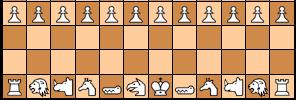
Three dimensional chess - Kogbetliantz game
One of the oldest forms of three dimensional chess was invented by dr. Ervand George Kogbetliantz. Kogbetliantz, a Russian mathematician, invented this game in 1918, when he was still living in Russia. In 1952, Kogbetliantz was living in the United States, and the game received much media attention. It was described in several U.S. magazines in 1952, including pictures of the inventor's chess set. It featured a board made of eight glass 8x8 boards stacked vertically in a cubical wooden frame from which they could slide out.
The articles were in these magazines:
Time Magazine February 4, 1952 Newsweek February 4, 1952 New Yorker April 12, 1952 Life Magazine June 9, 1952
There were pictures of the inventor's board in these articles. In it, the individual boards are made of glass and have the squares separated by dark lines - however, the squares themselves appear not to be colored (possibly for better visibility).
The following rules were bought from Dr. Kogbetliantz in the 1960's.
Rules
The board is considered as consisting of 512 "cases" (cubes, equivalent to squares on a 2-D chessboard) and the possible moves are described in terms of three elementary types: "move R" (for "Rook") through one of the 6 faces of a case; "move B" (for "Bishop"), through one of the 12 edges of a case; and "move F" (for "Fool", a new piece) through one of the 8 corners of a case.

As in chess, most pieces move in unlimited straight lines through empty "squares" and capture by landing on the first "square" occupied by an enemy piece. The pieces and their moves are as follows:
- Rook (r)
- Unlimited straight move in direction R
- Bishop (b)
- Unlimited straight move B
- Fool (f)
- Unlimited straight move F
- Favourite (F)
- Unlimited straight move in direction R or B
- Archbishop (Ar)
- Unlimited straight move in direction B or F
- Queen (Q)
- Unlimited straight move in direction R, B or F
- King (K)
- One case in direction R, B, or F
- Space-knight (Kn)
- Two consecutive one-case moves away from the starting case, either RB, RF, or BF. Jumps intervening pieces.
- Hippogriff (H)
- Straight move R of three cases followed by conventional knight's move at right angles to initial part of move. (In other words, the piece ends up at the opposite corner of a 4x3x2 cube rectangular solid from the starting point.) Jumps intervening pieces.
- Pawn (p)
- Moves forward one case in direction R (one or two on first move as in chess.) Captures by moving one case forward in direction B or F.
Rules about check, mate, en passant, castling are as in chess.
Positions are recorded as follows:
The floors are numbered I,II,III, ... upwards.
The files are lettered A,...,H from left to right as viewed by White.
The rows are numbered 1,...,8 from White toward Black
Initial position
The first and second rows from each side on floors III, IV, V, VI are filled with pieces as follows:
Level VI
 White:
Fool c1, f1; Bishop d1, e1; Pawn a1, a2, b1, b2, c2, d2, e2, f2, g1, g2, h1, h2.
Black:
Fool c8, f8; Bishop d8, e8;
Pawn a8, a7, b7, b7, c7, d7, e7, f7, g8, g7, h8, h7.
Level V
 White:
Rook a1, h1; Hippogriff b1, g1; Archbishop c1; Queen d1; Favorite e1; Knight
f1; Pawn a2, b2, c2, d2, e2, f2, g2, h2.
Black:
Rook a8, h8; Hippogriff b8, g8; Archbishop c8; Queen d8; Favorite e8; Knight
f8; Pawn a7, b7, c7, d7, e7, f7, g7, h7.
Level IV
 White:
Rook a1, h1; Hippogriff b1, g1; Knight c1; Favorite d1; King e1; Archbishop
f1; Pawn a2, b2, c2, d2, e2, f2, g2, h2.
Black:
Rook a8, h8; Hippogriff b8, g8; Knight c8; Favorite d8; King e8; Archbishop
f8; Pawn a7, b7, c7, d7, e7, f7, g7, h7.
Level III
White:
Fool c1, f1; Bishop d1, e1; Pawn a1, a2, b1, b2, c2, d2, e2, f2, g1, g2, h1, h2.
Black:
Fool c8, f8; Bishop d8, e8; Pawn a8, a7, b7, b7, c7, d7, e7, f7, g8, g7, h8, h7.
The other levels are empty.
Written by Bruce Grant and Hans Bodlaender. Thanks to Bruce Grant for spotting an error.
WWW page created: November 17, 1997. Last modified: December 15, 1997.